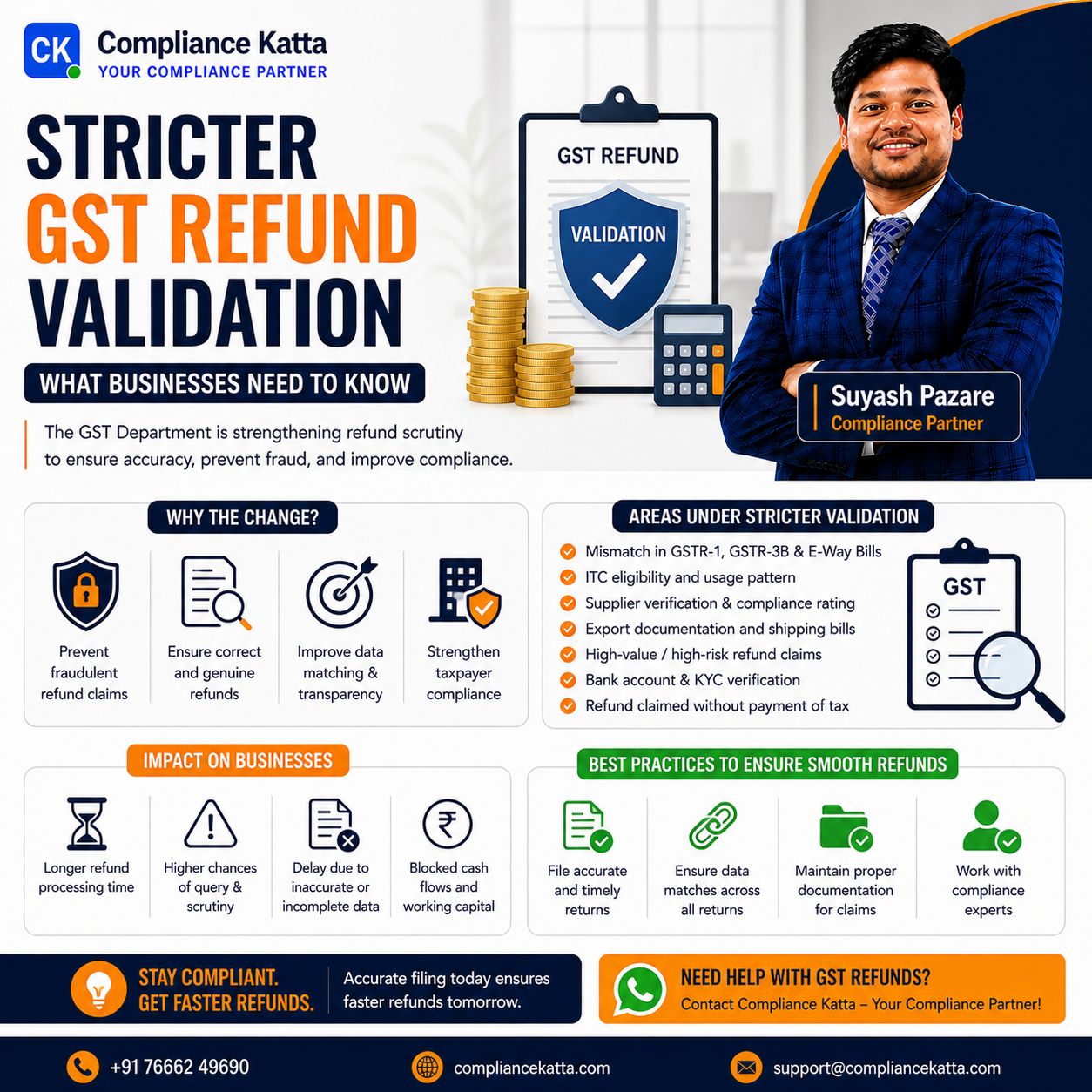
Introduction to the Evolving GST Refund Landscape
In a significant move towards full automation and digitization of the Goods and Services Tax (GST) framework, the Government has revamped the refund filing mechanism for claims relating to unutilized Input Tax Credit (ITC). The introduction of a new Annexure-B Offline Utility, replacing the earlier PDF-based Annexure-B in Form GST RFD-01, marks a pivotal step toward a more structured and technology-enabled refund ecosystem. At Compliance Katta, we recognize that while this shift promises faster processing, it also introduces rigorous system-driven validation that businesses must master to avoid rejections.
The Shift: From PDF-Based Annexure-B to JSON Utility
Previously, taxpayers were required to upload Annexure-B in a non-structured PDF format. Because this data was not machine-readable, tax authorities had to rely heavily on manual verification and departmental scrutiny, leading to longer processing times and discretionary interventions. The new mechanism requires taxpayers to use an offline utility to generate a JSON file.
Expert Insight: A JSON (JavaScript Object Notation) file is a machine-readable digital format. By switching to this format, the GST portal can now perform automated, invoice-level cross-verification with GSTR-2B data in real-time.
Key Highlights of the New Filing Process
- Transition to Automation: Moves away from manual officer-level scrutiny to system-based validation.
- Structured Data: The JSON utility ensures that every data point is captured in a standardized format.
- Invoice-Level Granularity: Refund claims are no longer summary-based; they are validated invoice by invoice.
- Faster Sanctions: For compliant taxpayers, the reduction in manual intervention will lead to quicker refund disbursements.
Detailed Comparison: Old Process vs. New Process
To help professionals understand the depth of this change, the following table outlines the fundamental shifts in the refund filing workflow:
| Feature | Earlier PDF-Based Process | New JSON-Based Utility |
|---|---|---|
| Data Format | Unstructured PDF document | Structured JSON machine-readable file |
| Verification Method | Manual scrutiny by Tax Officers | Automated system-based validation |
| Validation Source | Post-filing verification of records | Real-time cross-referencing with GSTR-2B |
| Invoice Details | Broad summaries often sufficed | Detailed invoice-wise bifurcation required |
| Risk of Rejection | Lower at filing; higher during audit | High at the filing stage due to data mismatches |
Enhanced Invoice-Level Reporting Requirements
The revised Annexure-B utility demands a much higher degree of precision. Taxpayers must now report granular details for every ITC entry included in the refund claim. This includes:
- Nature of Inward Supply: Clear categorization of whether the supply relates to inputs or input services.
- Document Type: Precise identification of invoices, debit notes, or supplementary invoices.
- ITC Bifurcation: Separation of eligible ITC and ineligible ITC, specifically identifying blocked credits under Section 17(5) of the CGST Act.
- GSTR-2B Linking: Mentioning the specific tax period in which the invoice was reflected in the recipient's GSTR-2B.
Impact Analysis for Exporters and Inverted Duty Structures
Exporters and businesses operating under an inverted duty structure (where tax on inputs is higher than tax on outputs) are the primary beneficiaries and the most impacted. The new system ensures that only ITC reflected in GSTR-2B is considered for refund. This eliminates the possibility of claiming refunds on invoices not uploaded by suppliers, effectively enforcing Rule 36(4) and Section 16(2)(aa) through the refund portal itself.
The Compliance Burden
While the goal is efficiency, the immediate result is an increased compliance burden. Businesses must now perform 100% reconciliation before clicking the submit button. Even minor discrepancies in invoice numbers or tax amounts between the JSON file and the portal records could trigger automated flags, leading to the issuance of deficiency memos.
Actionable Compliance Checklist for Professionals
At Compliance Katta, we recommend the following steps to ensure a seamless refund experience under the new regime:
- Pre-Filing Reconciliation: Conduct a thorough three-way match between your Purchase Register, GSTR-3B, and GSTR-2B.
- Section 17(5) Audit: Manually verify that no blocked credits (like motor vehicles or food and beverages, unless eligible) are included in the refund utility.
- Vendor Communication: Ensure all suppliers have filed their GSTR-1 accurately and on time; otherwise, the portal will block the corresponding refund.
- Data Validation: Use the Offline Utility’s built-in validation features to check for errors before generating the JSON file.
- Electronic Credit Ledger Match: Ensure the refund amount claimed does not exceed the balance available in the Electronic Credit Ledger at the time of filing and at the end of the relevant period.
Conclusion
The transition to a JSON-based Annexure-B utility represents the future of GST administration in India—one that is data-driven, transparent, and significantly less reliant on human discretion. For businesses, this means that the era of "approximate" filings is over. Precision, reconciliation, and proactive vendor management are now the cornerstones of a successful GST refund claim. By aligning internal processes with these digital updates, taxpayers can enjoy the benefits of a faster, non-discretionary refund process.
Common Questions
Q.What is the primary change in the GST refund filing process for ITC?
The primary change is the replacement of the PDF-based Annexure-B with a new JSON-based Offline Utility. This shift allows the GST portal to automatically read and validate invoice-level data against GSTR-2B records, moving away from manual, summary-based scrutiny.
Q.How does the new JSON utility impact GSTR-2B reconciliation?
The new utility makes GSTR-2B reconciliation mandatory for refund eligibility. If an invoice is not reflected in the GSTR-2B of the relevant period, the system-based validation may flag or reject that portion of the refund claim, ensuring that only tax actually paid by suppliers is refunded.
Q.Are blocked credits under Section 17(5) handled differently now?
Yes, the new Annexure-B utility requires explicit bifurcation of eligible and ineligible ITC. System validations are expected to identify blocked credits under Section 17(5) more effectively, requiring taxpayers to be extremely diligent in excluding such amounts from their refund applications.
Q.What should exporters do to prepare for this new validation process?
Exporters should implement robust internal reconciliation tools to match their purchase registers with GSTR-2B in real-time. They must ensure that every invoice reported in the JSON utility is perfectly aligned with the data available on the GST portal to prevent automated deficiency memos.
Q.Will the new process lead to faster GST refunds?
While the compliance requirements at the time of filing are stricter, the goal is to facilitate 'non-discretionary' sanctioning. By reducing manual intervention and providing machine-readable data, the tax department can process and sanction accurate claims much faster than the previous manual system.