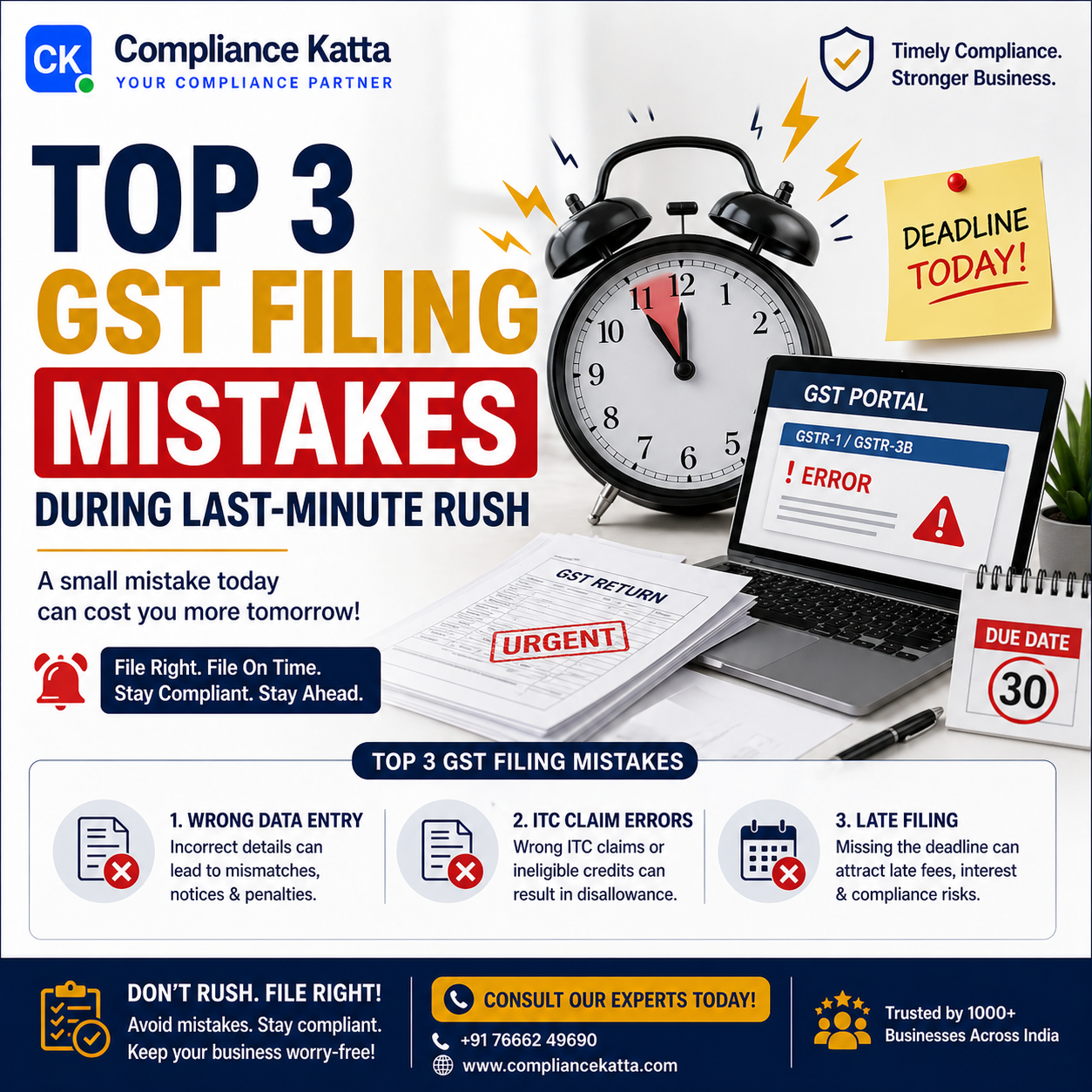
The High Cost of Haste: Navigating GST Deadlines
In India, the Goods and Services Tax (GST) regime is a rigorous framework that demands precision and punctuality. For many businesses, the 11th and 20th of every month represent high-pressure windows for filing GSTR-1 and GSTR-3B respectively. However, the last-minute rush often leads to clerical errors, oversight, and systemic failures that can result in hefty penalties, interest, and even the suspension of GST registration. At Compliance Katta, we believe that understanding these pitfalls is the first step toward robust financial health.
Key Highlights of GST Compliance Risks
- Interest Liability: Delay in tax payment or wrong ITC claim attracts interest under Section 50.
- Input Tax Credit (ITC) Blockage: Mismatches between GSTR-2B and GSTR-3B can lead to notices and credit reversals.
- Data Inconsistency: Discrepancies between turnover reported in GSTR-1 and tax paid in GSTR-3B trigger automated system flags.
The Top 3 GST Filing Mistakes During Last-Minute Rush
1. Claiming ITC Based on Books Instead of GSTR-2B
Perhaps the most frequent error made during the final hours of filing is claiming Input Tax Credit (ITC) based solely on internal accounting records. Since the implementation of Rule 36(4), ITC can only be claimed if the supplier has uploaded the invoice and it reflects in the recipient’s GSTR-2B.
Expert Advice: Always reconcile your purchase register with GSTR-2B before filing. Claiming ineligible ITC leads to mandatory interest at 18% per annum if the credit is utilized.
2. Incorrect Classification of Supplies and Tax Heads
Under pressure, taxpayers often misclassify Inter-State supplies (IGST) as Intra-State (CGST + SGST) or vice versa. Furthermore, failing to distinguish between B2B and B2C transactions in GSTR-1 can lead to significant issues for the recipient’s credit availability.
3. Overlooking Reverse Charge Mechanism (RCM) Liability
RCM requires the recipient of services to pay tax directly to the government. During a last-minute rush, many accountants forget to include liabilities for services like legal fees, GTA services, or imports. Failure to pay RCM tax in cash (it cannot be paid using ITC) results in immediate non-compliance.
Impact Analysis of Filing Errors
| Category of Error | Financial Impact | Compliance Consequence |
|---|---|---|
| ITC Mismatch | 18% Interest + Penalty | Scrutiny under ASMT-10 |
| Reporting Error | Difficult Rectification | GSTR-9/9C Reconciliation Issues |
| Late Filing | Per Day Late Fee | Low GST Compliance Rating |
The Path to Accurate Filing: A Flowchart View
1. Data Aggregation: Consolidate Sales and Purchase registers by the 5th of the month.2. Reconciliation: Run an automated check between GSTR-2B and Books.3. Drafting: Prepare GSTR-1 and verify HSN summaries.4. Validation: Cross-check GSTR-1 data with GSTR-3B liabilities.5. Final Submission: File at least 2 days before the deadline to avoid server issues.Compliance Checklist: Actionable Steps
- Verify HSN/SAC Codes: Ensure 4 or 6-digit HSN codes are accurate as per turnover limits.
- Zero-Rated vs Exempted: Do not confuse Nil-rated supplies with Export/SEZ (Zero-rated) supplies.
- Payment Ledger: Check the Cash and Credit Ledger balances before final offset.
- Amendment Check: Review if any invoices from previous months need credit notes or debit notes adjustments.
- Final EVC/DSC: Ensure your Digital Signature or EVC credentials are active and not expired.
Conclusion
The complexity of GST laws makes errors easy to commit but difficult to correct. While the GST portal has evolved, the burden of accuracy remains with the taxpayer. By avoiding the last-minute rush and implementing a mid-month review cycle, businesses can safeguard themselves against litigation. For professional assistance and end-to-end management, Compliance Katta stands ready to be your strategic partner in navigating the intricate landscape of Indian taxation.
Common Questions
Q.Can I revise my GST return once it has been filed?
Currently, the GST law does not allow for the 'Revision' of a filed return like Income Tax. However, any errors or omissions made in a particular month can be rectified in the subsequent month's return or through the Annual Return (GSTR-9). It is crucial to make these corrections as soon as the error is identified to minimize interest liability.
Q.What is the penalty for failing to report RCM transactions?
If RCM liability is not reported and paid, the taxpayer must pay the tax amount along with interest at 18% per annum from the date it was due. Additionally, since RCM must be paid in cash, you cannot use existing ITC to discharge this liability, making it a direct hit on your cash flow.
Q.Why is GSTR-2B reconciliation so important for ITC?
GSTR-2B is a static statement that determines your eligibility for Input Tax Credit. If you claim more ITC in your GSTR-3B than what is available in GSTR-2B, the GST department will issue a notice (often Form DRC-01B) demanding an explanation or payment of the excess credit claimed.
Q.What are the consequences of mismatched HSN codes?
Incorrect HSN codes can lead to the application of the wrong tax rate. If you report a lower rate due to a wrong HSN, you will be liable to pay the differential tax with interest. Furthermore, consistent HSN errors can trigger an audit as the system tracks commodity-wise trends.
Q.How does late filing affect my business's GST compliance rating?
Every GSTIN has a compliance profile visible to the tax authorities. Frequent late filings and error-prone returns lower your credibility, which may lead to delayed GST refunds, increased frequency of scrutiny, and difficulty in obtaining E-Way bills if defaults persist for two consecutive months.