In this article
Introduction & Regulatory Context
The Central Board of Indirect Taxes and Customs (CBIC) has announced significant amendments to the Goods and Services Tax (GST) framework, bringing into effect new provisions for the Reverse Charge Mechanism (RCM), GST registration, and Tax Deducted at Source (TDS). These crucial changes, stemming from a series of GST-related notifications issued by the Central Government on October 27, 2026, are effective from November 1, 2026. This update is particularly vital for businesses across Pune and Pan-India engaged in the trade, processing, or consumption of specified waste and scrap materials, as it fundamentally alters their tax liabilities and compliance protocols.
The objective behind these amendments is to streamline tax collection, prevent revenue leakage, and ensure a more robust compliance ecosystem, especially within sectors that have historically posed challenges in tax administration. Businesses must promptly understand and integrate these new rules to avoid non-compliance risks.
Key Amendments to GST Provisions
The recent CBIC notifications introduce several pivotal changes that demand immediate attention:
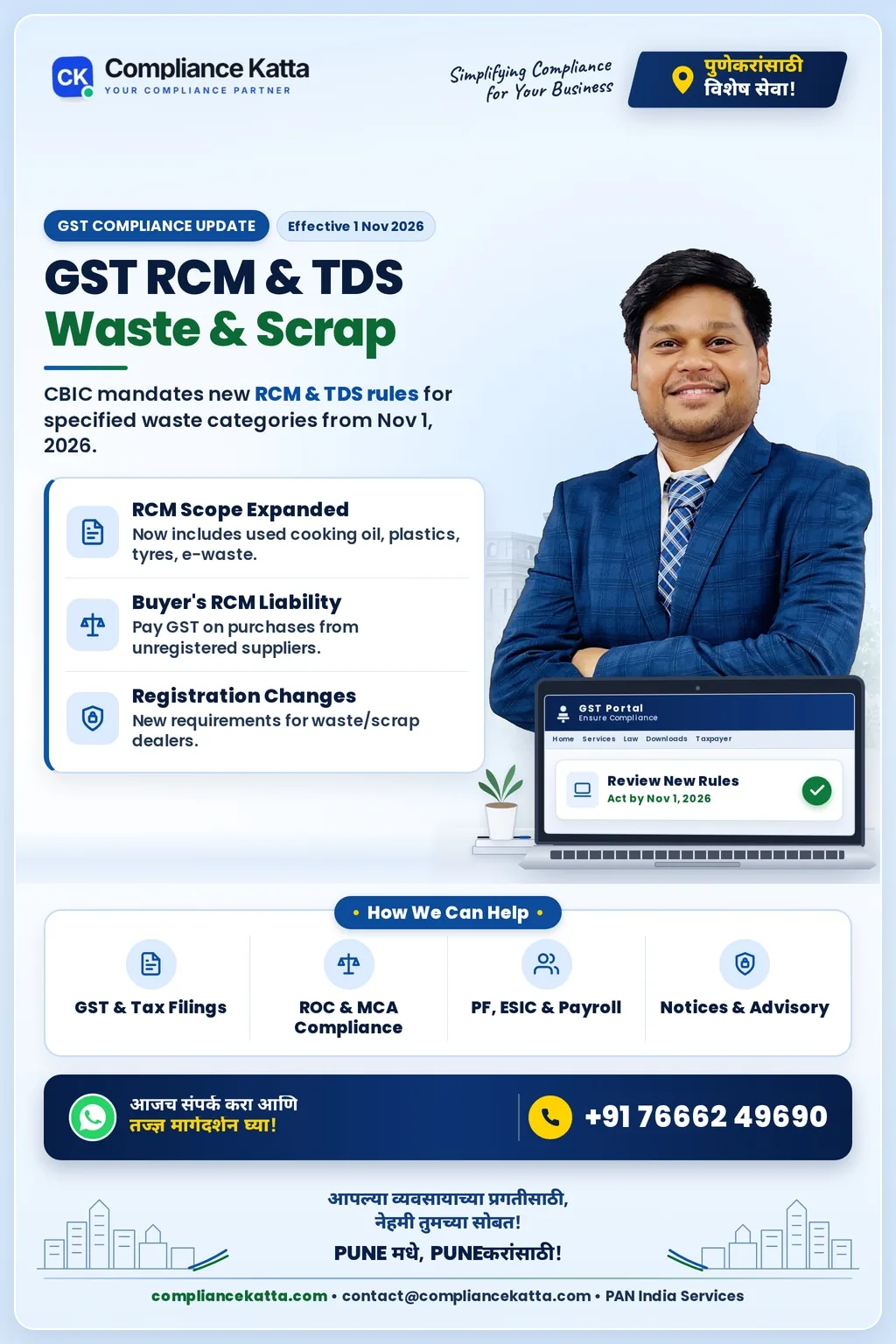
- Expanded Scope of Reverse Charge Mechanism (RCM): The RCM framework has been significantly extended to cover the supply of specific waste and scrap categories. This explicitly includes items such as used cooking oil, various types of plastics, discarded tyres, and electronic waste. This means that for these specified goods, the recipient of the supply, rather than the supplier, will be liable to pay GST.
- Buyer's Liability for Unregistered Suppliers: A critical implication of the RCM extension is that businesses purchasing these newly specified waste and scrap items from unregistered suppliers will now bear the responsibility of paying GST under the RCM framework. This shifts the compliance burden to the registered buyer, ensuring tax collection even when the initial supplier is not registered under GST.
- Changes to GST Registration Requirements: Accompanying these RCM changes are modifications to GST registration requirements. Entities primarily engaged in dealing with these particular waste and scrap categories may face new or altered registration obligations, necessitating a review of their current GST registration status and potential need for amendments or new registrations.
- Introduction of New TDS Provisions: In addition to RCM and registration changes, new Tax Deducted at Source (TDS) provisions are being introduced for transactions involving the aforementioned specified waste and scrap categories. This will require specified recipients to deduct tax at source on payments made for these supplies, further enhancing tax compliance and traceability.
Comparative Summary of Key Changes
| Provision | Old Rule (Pre-Nov 1, 2026) | New Rule (From Nov 1, 2026) |
|---|---|---|
| RCM Applicability | Limited to specific goods/services | Extended to specified waste/scrap (UCO, plastics, tyres, e-waste) |
| Buyer's Liability (Unregistered Supplier) | Generally forward charge | RCM applicable for specified waste/scrap |
| GST Registration | General rules apply | Specific changes for waste/scrap dealers |
| TDS Provisions | Existing rules for specified supplies | New TDS provisions for specified waste/scrap |
Impact on Businesses & Compliance Obligations
This update primarily impacts businesses, GST practitioners, and tax professionals, especially those involved in the trade or processing of specified waste and scrap materials. This includes manufacturers, recyclers, traders, and even restaurants or industrial units generating used cooking oil or electronic waste. The shift in tax liability under RCM means that buyers must now account for GST on their purchases, which was previously the supplier's responsibility. This necessitates changes in accounting systems, vendor management, and cash flow planning.
For businesses dealing with unregistered suppliers of these materials, the onus of paying GST moves entirely to them. This requires robust due diligence on supplier registration status and accurate classification of goods. Furthermore, the new TDS provisions will add another layer of compliance, requiring businesses to deduct and deposit tax at source, and file corresponding TDS returns.
Expert Advice from Compliance Katta: Given the complexity and immediate effective date of these changes, businesses in Pune and across India must conduct a thorough review of their procurement processes, vendor agreements, and accounting systems. Proactive engagement with GST professionals is crucial to ensure seamless transition and compliance with the new RCM, registration, and TDS provisions. Non-compliance can lead to significant financial penalties and interest liabilities.
Practical Compliance Checklist for Businesses
To navigate these new GST notifications effectively, businesses should undertake the following actions:
- Identify Impacted Supplies: Determine if your business deals with used cooking oil, plastics, tyres, electronic waste, or any other newly specified waste and scrap categories, either as a supplier or a recipient.
- Review Procurement Processes: For purchases of specified waste/scrap, identify if your suppliers are registered under GST. If they are unregistered, prepare to pay GST under RCM.
- Update Accounting Systems: Ensure your accounting and ERP systems are configured to correctly identify RCM liabilities and TDS deductions for these specific transactions.
- Assess GST Registration Status: Verify if your current GST registration is adequate, or if new registration or amendments are required based on your involvement with these waste/scrap categories.
- Implement TDS Procedures: Understand the new TDS rates and provisions for specified waste/scrap transactions and set up internal processes for deduction, deposit, and return filing.
- Educate Internal Teams: Train your procurement, finance, and accounting teams on the new RCM and TDS rules to ensure accurate compliance from November 1, 2026.
- Monitor CBIC Updates: Stay vigilant for any further clarifications or detailed guidelines from CBIC regarding these notifications.
The changes outlined in these notifications came into force on November 1, 2026. While the specific figures for late fees or penalties are not detailed, non-compliance with GST regulations, including RCM and TDS provisions, typically attracts interest and penalties as per the Goods and Services Tax Act, 2017. Timely compliance is paramount to avoid these adverse consequences.
Conclusion
The CBIC's latest GST notifications mark a significant shift in the compliance landscape for businesses dealing with specific waste and scrap materials. The extension of RCM, coupled with new registration and TDS provisions, underscores the government's commitment to broadening the tax base and enhancing compliance. Businesses, particularly those operating in Pune and Pan-India, must act swiftly to understand these changes and adapt their operations accordingly. Proactive measures, including system updates and expert consultation, will be key to ensuring seamless adherence to the revised GST framework.
Disclaimer: This update is for general informational and educational purposes only and does not constitute formal legal, tax, or professional advice. Applicability may vary based on specific facts, turnover thresholds, and subsequent notifications. Please consult a qualified professional before acting on this information. For Pune & pan-India compliance assistance, contact Compliance Katta on WhatsApp at +91 76662 49690.
Common Questions
Q.What specific waste and scrap categories are now covered under the extended RCM?
The Reverse Charge Mechanism (RCM) has been extended to explicitly cover supplies of specified waste and scrap categories, including used cooking oil, various types of plastics, discarded tyres, and electronic waste. Businesses dealing with these materials must now account for GST under RCM if purchasing from unregistered suppliers.
Q.As a buyer, what is my responsibility if I purchase these specified waste materials from an unregistered supplier?
If you are a registered business purchasing any of the newly specified waste and scrap items (like used cooking oil, plastics, tyres, or electronic waste) from an unregistered supplier, you will now be responsible for paying GST under the Reverse Charge Mechanism (RCM) framework. This shifts the tax liability from the supplier to you, the recipient.
Q.Are there any changes to GST registration requirements for businesses dealing with waste and scrap?
Yes, the notifications include accompanying changes to GST registration requirements for entities engaged in dealing with these particular waste and scrap categories. Businesses should review their current registration status and assess if new registrations or amendments are necessary to comply with the updated provisions.
Q.What are the new TDS provisions related to these waste and scrap categories?
New Tax Deducted at Source (TDS) provisions are being introduced for transactions involving the aforementioned specified waste and scrap categories. This means that for certain transactions, the recipient making the payment will be required to deduct tax at source and remit it to the government, in addition to any RCM liabilities.
Q.What are the potential consequences of non-compliance with these new GST rules?
The changes came into force on November 1, 2026. While specific penalty figures are not detailed in the brief, non-compliance with GST regulations, including RCM and TDS provisions, typically attracts interest on unpaid tax and penalties as per the Goods and Services Tax Act. Businesses should ensure timely adherence to avoid financial repercussions.