Introduction to GSTR-10 Final Return Post-Cancellation
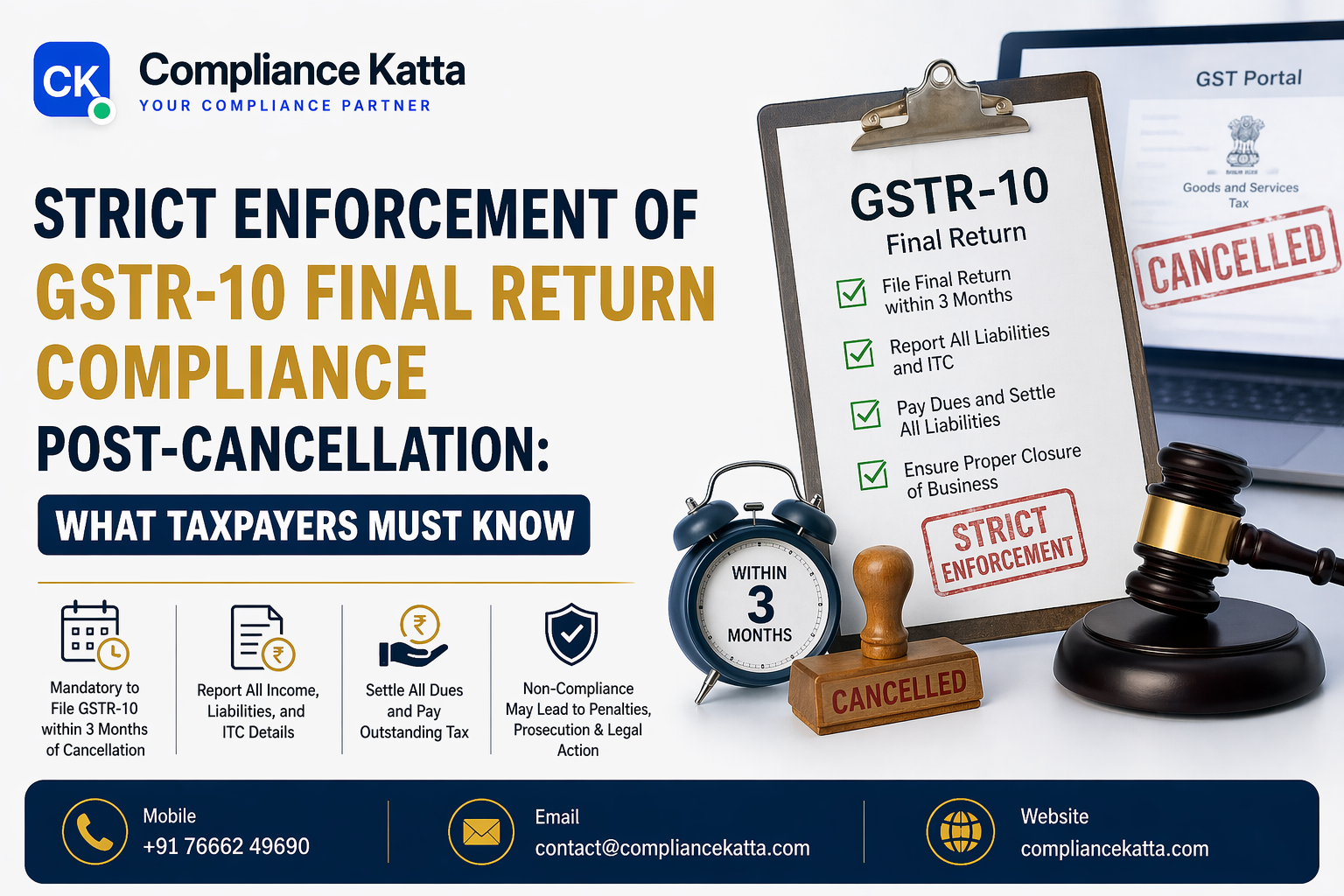
The Goods and Services Tax (GST) framework in India demands rigorous adherence to compliance, not just during the operational lifecycle of a business, but equally during its closure. Recent updates emphasize the Strict Enforcement of GSTR-10 Final Return Compliance post-cancellation of GST registration. The tax authorities have observed that many taxpayers, upon receiving a cancellation order, fail to accurately discharge their pending liabilities, particularly the interest accrued on late filing of their final period's GSTR-3B. To bridge this revenue leakage, the GST portal and jurisdictional officers are now strictly mandating that any interest liability pertaining to the final GSTR-3B must be collected and settled via the Form GSTR-10 (Final Return). Failure to comply will result in an incomplete tax closure and invite hefty penalties.
Professional Warning: Taxpayers cannot simply abandon their GSTIN after applying for cancellation. The exit process is only legally complete once Form GSTR-10 is filed with all taxes, late fees, and interest fully paid.
Key Highlights of the New GSTR-10 Enforcement
- Mandatory Interest Collection: Any interest accrued due to the delayed filing of the last GSTR-3B return will now be auto-populated or strictly scrutinized for payment within the GSTR-10 return.
- Prerequisite for Tax Closure: The GST cancellation process remains technically open and subject to departmental audit until the Final Return is successfully filed.
- Late Fee Mechanism: Filing GSTR-10 beyond the stipulated 90 days from the date of the cancellation order or the date of cancellation (whichever is later) attracts a maximum late fee of Rs. 10,000 (Rs. 5,000 CGST + Rs. 5,000 SGST).
- Recovery Proceedings: Non-compliance post-cancellation will trigger automated recovery notices under Section 79 of the CGST Act.
Impact Analysis on Indian Businesses
For Indian businesses shutting down operations, restructuring, or transitioning out of the GST threshold, this strict enforcement carries substantial financial and legal implications. Previously, taxpayers assumed that the cancellation order was the final step. Under the new strictures, the final period's GSTR-3B must be reconciled with the GSTR-10. If a business delayed its last GSTR-3B, the interest under Section 50 of the CGST Act (at 18% per annum) will become a mandatory payable component in GSTR-10. This ensures the exchequer does not lose out on time-value of money. Businesses will now need to maintain adequate funds in their Electronic Cash Ledger to offset this interest liability during the final exit, requiring meticulous financial planning. Leaving this unresolved can lead to the freezing of business bank accounts and attachment of assets even after the business has supposedly closed.
Comparison: Final GSTR-3B vs GSTR-10
| Parameter | Final Period GSTR-3B | GSTR-10 (Final Return) |
|---|---|---|
| Purpose | Declares outward supplies and claims ITC for the last active month. | Declares stock held on the day before cancellation to reverse ITC. |
| Due Date | 20th of the subsequent month. | Within 3 months of cancellation or order date, whichever is later. |
| Interest Liability | Calculated on delayed payment of output tax. | Now serves as the collection mechanism for pending final GSTR-3B interest. |
| Consequence of Default | Blocks GSTR-1 filing and incurs standard late fees. | Prevents legal closure of GSTIN and invites flat late fees up to Rs. 10,000 plus notices. |
Process Flow for GST Cancellation and Final Return Compliance
Step-by-Step Compliance Flowchart:- Application: Taxpayer files REG-16 for cancellation of GST registration.
- Clearance: Taxpayer files all pending GSTR-1 and GSTR-3B returns leading up to the cancellation date.
- Order Issuance: Proper Officer approves the application and issues REG-19 (Cancellation Order).
- Stock Valuation: Taxpayer calculates ITC reversal required on inputs, capital goods, and semi-finished goods held in stock.
- Interest Calculation: Taxpayer computes any pending interest from late GSTR-3B filings to be discharged.
- Filing GSTR-10: Taxpayer logs in, pays the ITC reversal amount and the mandated interest via the Electronic Cash Ledger, and files GSTR-10.
Actionable Compliance Checklist
To ensure a seamless and penalty-free GST deregistration, businesses must adhere to the following checklist:
- Verify the Cancellation Order: Check the exact effective date of cancellation and the date of the REG-19 order to calculate your 90-day GSTR-10 deadline accurately.
- Calculate Reversal Liabilities: Accurately compute the Input Tax Credit (ITC) reversal required on closing stock and capital goods as per Section 29(5) of the CGST Act.
- Reconcile Final GSTR-3B: Ensure your last GSTR-3B is filed and meticulously calculate any interest under Section 50 for late tax payments.
- Ensure Cash Ledger Balance: Deposit sufficient funds into the Electronic Cash Ledger to cover the GSTR-10 ITC reversal and the mandated interest liabilities, as ITC cannot be used to pay interest.
- Monitor Departmental Notices: Keep checking the GST portal dashboard for any ASMT-10 or automated notices demanding final settlements.
- Consult Experts: Engage with professionals at Compliance Katta to review your exit filings and avoid legal pitfalls.
Conclusion
The strict enforcement of GSTR-10 Final Return compliance is a clear signal from the GST Council that the exit process is being monitored just as closely as onboarding and regular compliance. Ignoring the interest liabilities of the final GSTR-3B or delaying the GSTR-10 filing will lead to unnecessary financial losses through exorbitant late fees and recovery proceedings. Proper planning, timely reconciliation, and expert guidance are essential for a clean exit. If you are in the process of closing your business or surrendering your GSTIN, do not navigate this complex legal terrain alone. Reach out to Compliance Katta today for comprehensive end-to-end GST cancellation and GSTR-10 compliance support.
Common Questions
Q.What is Form GSTR-10 and who is required to file it?
Form GSTR-10, also known as the Final Return, must be filed by taxpayers whose GST registration has been cancelled or surrendered. It is mandatory for regular taxpayers to declare the stock held on the day immediately preceding the date of cancellation and reverse the corresponding Input Tax Credit (ITC).
Q.What is the due date for filing the GSTR-10 Final Return?
The GSTR-10 must be filed within three months of the date of cancellation or the date of the cancellation order, whichever is later. Failure to meet this deadline will attract significant late fees and potential recovery actions from the tax department.
Q.How is the interest for the final GSTR-3B handled under the new strict enforcement?
Under the recent updates, any interest liability arising from the delayed filing and payment of the final period's GSTR-3B is now strictly monitored. Taxpayers are required to settle this accumulated interest liability during the filing of their GSTR-10 Final Return to achieve complete tax closure.
Q.What is the penalty for not filing the GSTR-10 Final Return on time?
Delaying the GSTR-10 filing incurs a late fee of Rs. 200 per day (Rs. 100 CGST + Rs. 100 SGST). This late fee is capped at a maximum of Rs. 10,000 (Rs. 5,000 CGST and Rs. 5,000 SGST), emphasizing the need for timely compliance.
Q.Can I use my Electronic Credit Ledger to pay the interest and late fees in GSTR-10?
No, interest and late fees cannot be paid using the Electronic Credit Ledger. Taxpayers must deposit actual cash into their Electronic Cash Ledger to discharge these specific liabilities during the GSTR-10 filing process.