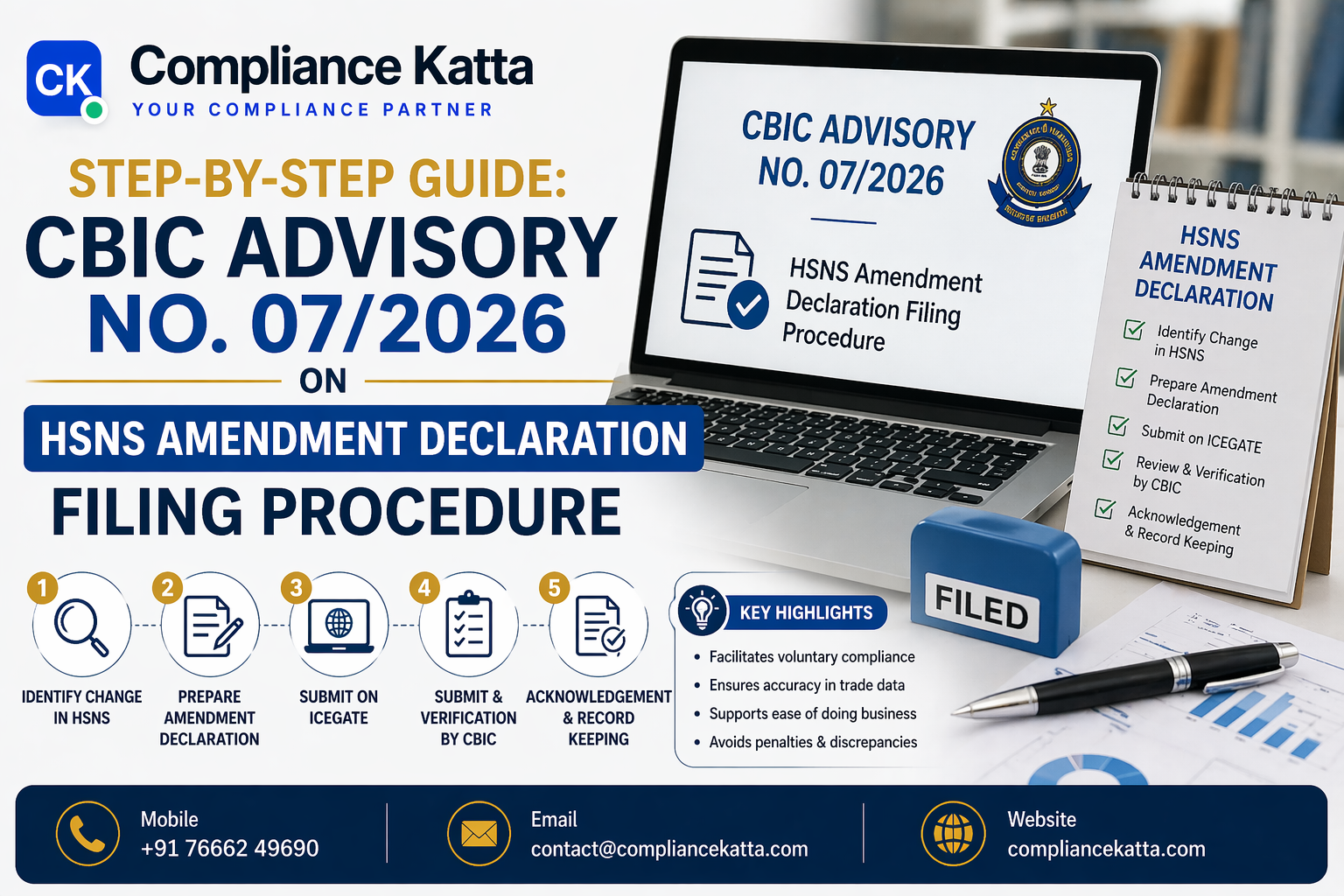
Introduction to HSNS Amendment Declarations under GST
The Central Board of Indirect Taxes and Customs (CBIC) has recently released Advisory No. 07/2026, which specifically addresses the procedural nuances for filing the HSNS Amendment Declaration. This advisory is targeted at taxpayers registered under the HSNS (Harmonized System of Nomenclature for Softwood/Specialized Goods) Cess legislation. As the GST framework evolves, ensuring that HSN codes and corresponding Cess rates are accurately reported is paramount to avoiding litigation and ensuring smooth credit flow.
This advisory provides a much-needed mechanism for taxpayers to rectify errors or update their initial declarations made under the specialized cess provisions. At Compliance Katta, we understand that these technical updates can be daunting for businesses; hence, we have dissected this advisory to provide a clear roadmap for compliance.
Key Highlights of Advisory No. 07/2026
- Correction Window: The advisory introduces a formal window for amending previously submitted HSNS declarations on the common portal.
- Target Audience: Specifically applicable to taxpayers registered under the HSNS Cess legislation and those required to declare specific commodity details.
- Validation Checks: The portal will now include automated validation to ensure that amended HSN codes align with the prescribed Cess rates.
- System-Generated Acknowledgments: Upon successful filing of the amendment, the system will generate a unique reference number for future tracking.
- Non-Retrospective Limitation: While amendments are permitted, they must generally align with the financial year or the tax period to which the original declaration pertained.
Professional Tip: Before initiating an amendment, ensure that your books of accounts and GSTR-1 filings reflect the same HSN details to prevent data mismatches during departmental audits.
Detailed Procedural Steps for Filing
To ensure a seamless filing experience, taxpayers should follow the structured workflow provided by the GST portal as outlined in the new advisory. The process is digital-first and requires authentication via Digital Signature Certificate (DSC) or Electronic Verification Code (EVC).
1. Accessing the Portal: Log in to the GST Common Portal using valid credentials.2. Navigation: Navigate to Services > User Services > My Applications and select 'HSNS Amendment Declaration' from the dropdown menu.3. Selection of Period: Choose the relevant Financial Year and the specific declaration period that requires correction.4. Data Modification: The system will display the original values. Enter the revised HSN codes or Cess values in the 'Amended' column.5. Verification: Upload any necessary supporting documents (if prompted) and verify the declaration using EVC/DSC.Comparison: Original vs. Amended Declaration
The following table illustrates the core differences and the scope of changes permitted under the new advisory:
| Feature | Original Declaration | Amended Declaration |
|---|---|---|
| Purpose | Initial reporting of HSN and Cess rates. | Correction of clerical errors or rate updates. |
| Frequency | One-time filing per tax period. | Permitted based on specific conditions in Advisory 07/2026. |
| Validation | Basic HSN format check. | Stringent mapping of HSN vs. Cess Legislative Rates. |
| Document Requirement | Standard registration documents. | Reason for amendment and supporting invoices (if requested). |
Impact Analysis for Indian Businesses
The introduction of the HSNS Amendment Declaration filing procedure has significant implications for sectors such as tobacco, aerated drinks, and motor vehicles where cess is a major component of the tax liability. For these industries, even a minor error in HSN classification can lead to substantial financial discrepancies.
1. Enhanced Data Accuracy
By allowing amendments, the CBIC is fostering an environment of self-correction. Businesses can now proactively rectify errors before they are flagged by the GST analytics wing, thereby reducing the likelihood of receiving show-cause notices (SCNs).
2. Supply Chain Synchronization
Accurate HSNS declarations ensure that the Input Tax Credit (ITC) passed down the supply chain is valid. If the HSN or Cess rate is misdeclared, it could lead to the blockage of credit for the recipient, straining vendor relationships.
3. Audit Preparedness
With Advisory No. 07/2026, the digital trail of amendments is maintained. This transparency helps Compliance Katta clients during GST audits, as the reasons for changes are documented and timestamped on the portal.
Comprehensive Compliance Checklist
Taxpayers should utilize the following checklist to ensure compliance with the new advisory:
- Verify the existing HSN codes against the latest Customs and GST rate notifications to ensure current validity.
- Assess the impact of the amendment on the total tax liability already paid in GSTR-3B.
- Ensure that the authorized signatory is available for EVC/DSC authentication to avoid last-minute delays.
- Download the 'Draft Amendment' PDF from the portal for internal review before final submission.
- Maintain a record of the original vs. amended data along with a brief justification for the change for future reference.
- Reconcile the amended declaration data with the annual return (GSTR-9) if the amendment pertains to a previous financial year.
Conclusion
The CBIC Advisory No. 07/2026 is a proactive step toward simplifying the compliance burden for taxpayers dealing with specialized cess. By providing a clear procedure for HSNS Amendment Declarations, the government is emphasizing the importance of accurate data reporting in the GST ecosystem. Businesses are encouraged to review their past declarations and utilize this amendment facility to ensure their records are beyond reproach. For personalized assistance and expert guidance on GST amendments, Compliance Katta remains your trusted partner in navigating the complexities of Indian tax laws.
Common Questions
Q.What is the primary purpose of CBIC Advisory No. 07/2026?
The primary purpose of Advisory No. 07/2026 is to provide a detailed procedural framework for taxpayers to amend their HSNS (Harmonized System of Nomenclature for Specialized Cess) declarations. This allows for the correction of errors in HSN codes or Cess rates that were previously submitted on the GST portal.
Q.Who needs to file the HSNS Amendment Declaration?
This amendment filing is specifically required for taxpayers who are registered under the legislation pertaining to HSNS Cess. It applies to businesses dealing in goods that attract specific cess rates where detailed HSN-wise reporting is mandatory.
Q.Can I amend a declaration for a previous financial year?
Yes, the advisory generally permits amendments for previous periods, provided they fall within the timelines allowed by the portal's technical constraints and the overarching GST law. It is crucial to check the specific 'Financial Year' selection dropdown on the portal for available periods.
Q.What happens if the amended HSN code does not match the Cess rate?
The GST portal has integrated automated validation checks as per the new advisory. If the amended HSN code does not correspond to the legal Cess rate defined in the system's master data, the portal will display an error and prevent the submission of the amendment.
Q.Is there a fee or penalty for filing an HSNS Amendment Declaration?
As of the current advisory, there is no specific 'filing fee' for the amendment declaration itself. However, if the amendment reveals an underpayment of tax or cess, the taxpayer may be liable to pay the differential amount along with applicable interest under Section 50 of the CGST Act.