In this article
Introduction & Regulatory Context
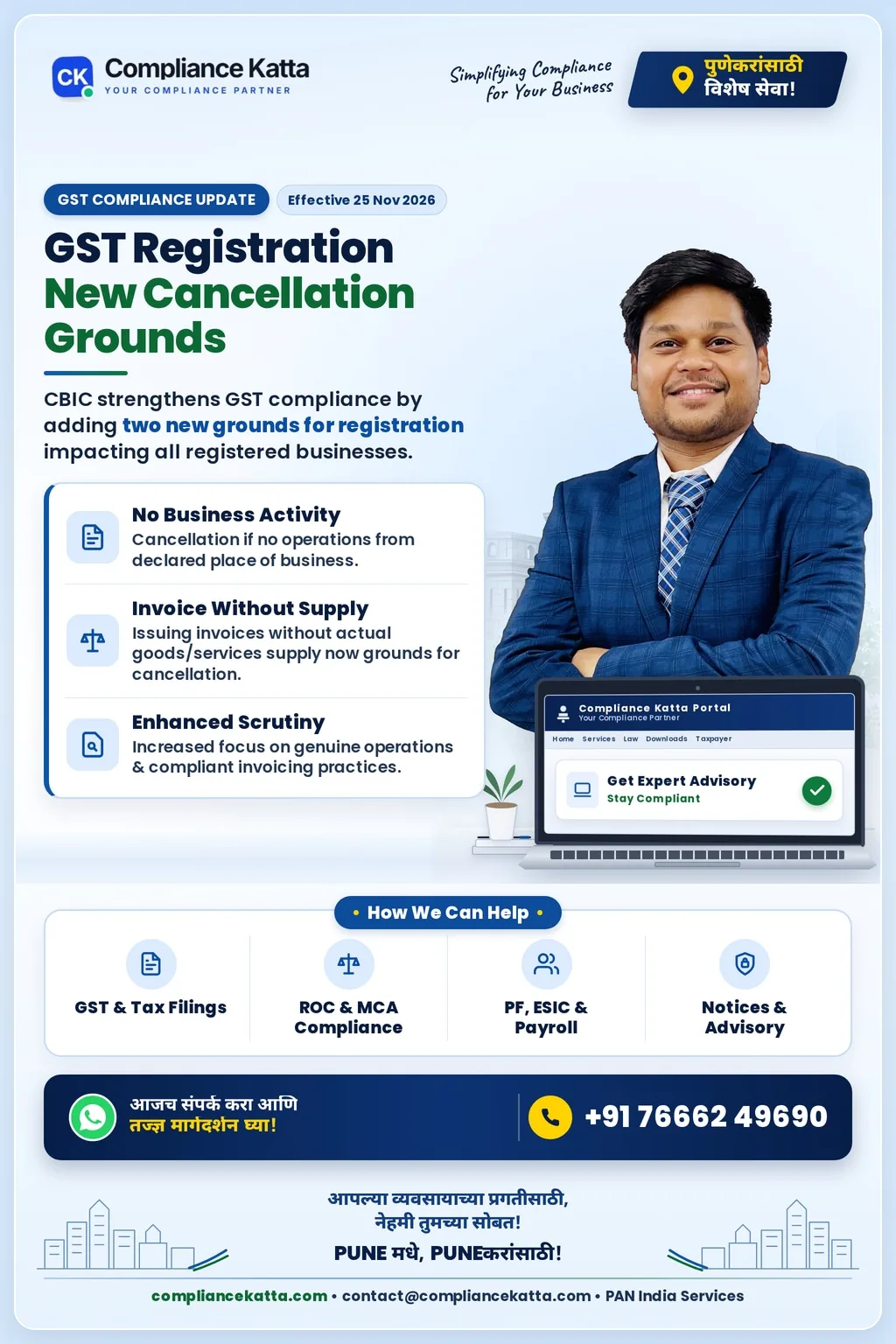
The Central Board of Indirect Taxes and Customs (CBIC), under the Ministry of Finance, has once again demonstrated its commitment to strengthening the Goods and Services Tax (GST) regime in India. Through a significant corrigendum, published on November 25, 2026, the CBIC has introduced two pivotal new grounds for the cancellation of GST registration. This update, officially Corrigendum Notification No. G.S.R. 1005(E) dated November 25, 2026, corrects the English version of the Central Goods and Services Tax (Amendment) Rules, 2026, originally issued vide G.S.R. 919(E) dated October 26, 2026. These amendments are a clear signal from the authorities to curb non-genuine business operations and combat improper invoicing practices that undermine the integrity of the GST system.
For all GST-registered businesses and taxpayers across Pune and Pan-India, this development necessitates immediate attention. The new provisions are designed to ensure that only legitimate businesses operate within the GST framework, thereby enhancing transparency and reducing instances of tax evasion. Compliance Katta advises all businesses to thoroughly understand these changes and align their operational and invoicing practices accordingly to avoid severe repercussions, including the cancellation of their GST registration.
Key Amendments & Their Implications
The corrigendum introduces two specific and potent grounds for GST registration cancellation, significantly broadening the scope of the authorities' power to act against non-compliant entities:
- No Business Activity at Declared Place: A GST registration can now be cancelled if a registered person does not conduct any business from the place of business declared at the time of registration. This targets shell companies or entities that obtain GST registration merely to facilitate fraudulent activities without having a genuine operational base. It underscores the importance of maintaining a verifiable physical presence and conducting actual business operations from the registered address.
- Invoice Issuance Without Actual Supply: GST registration is now liable for cancellation if a registered person issues an invoice or bill without the actual supply of goods or services or both, in violation of the provisions of the CGST Act or the rules made thereunder. This provision directly addresses the menace of "fake invoicing," where invoices are issued to pass on Input Tax Credit (ITC) without any underlying supply, leading to significant revenue leakage and fraudulent claims.
These amendments highlight an enhanced scrutiny by the CBIC on the authenticity of business operations and the integrity of invoicing practices. Taxpayers are now under increased obligation to ensure that their declared place of business is genuinely operational and that every invoice issued corresponds to an actual supply of goods or services.
Comparative Overview: Old vs. New Grounds
To better understand the impact of these changes, let's compare the regulatory landscape before and after this corrigendum:
| Aspect | Previous Scenario (Pre-Nov 25, 2026) | New Scenario (Post-Nov 25, 2026) |
|---|---|---|
| Business Activity at Declared Place | General non-compliance grounds existed, but 'no business activity from declared place' was not an explicit, standalone ground for cancellation. | Explicit and direct ground for GST registration cancellation if no business is conducted from the place of business declared at the time of registration. |
| Invoice Issuance without Actual Supply | Provisions against fraudulent invoicing and misrepresentation were present, but issuing invoices without actual supply was not a distinct, explicit ground for registration cancellation. | Explicit and direct ground for GST registration cancellation if invoices are issued without the actual supply of goods or services or both. |
| Regulatory Focus | Broader compliance with GST laws, with a focus on timely filings and tax payments. | Heightened scrutiny on the authenticity and genuineness of business operations, strict adherence to invoicing rules, and combating shell entities. |
The shift indicates a move towards more targeted enforcement, aiming to filter out non-genuine taxpayers and ensure a robust, compliant GST ecosystem.
Practical Compliance Checklist for Businesses
Given these significant changes, all GST-registered businesses, particularly those operating in Pune and across India, must take proactive steps to ensure full compliance:
- Verify Business Operations: Ensure that actual business activities are being conducted from the place of business declared in your GST registration. If there has been a change in your principal place of business, ensure it is updated promptly with the GST authorities.
- Review Invoicing Practices: Implement stringent internal controls to ensure that every invoice or bill issued corresponds to an actual supply of goods or services. Avoid any practice of issuing invoices merely to facilitate ITC claims without underlying transactions.
- Maintain Proper Records: Keep meticulous records of all supplies, invoices, e-way bills, and other relevant documents to substantiate your business operations and supplies.
- Educate Staff: Ensure that all personnel involved in invoicing, logistics, and compliance are aware of these new grounds for cancellation and the severe implications of non-compliance.
- Seek Professional Guidance: If there are any ambiguities regarding your current operations or invoicing practices, consult with GST experts to ensure full adherence to the updated rules.
Expert Advice from Compliance Katta: "These new grounds for GST registration cancellation are a critical step by CBIC to enhance the integrity of the GST system. Businesses must now prioritize not just timely filings, but also the absolute authenticity of their operations and invoicing. Any deviation can lead to severe consequences, including business disruption and loss of Input Tax Credit. Proactive review and adherence are paramount for sustained compliance and business continuity in Pune and across India."
Conclusion & Expert Advisory
The Corrigendum Notification No. G.S.R. 1005(E) dated November 25, 2026, marks a pivotal moment in GST enforcement. By explicitly adding "no business activity at declared place" and "invoice issuance without actual supply" as grounds for registration cancellation, the CBIC has armed itself with stronger tools to combat fraudulent practices. These changes are effective immediately from November 25, 2026. Failure to comply can lead to the cancellation of GST registration, which in turn can result in significant business disruption, inability to collect input tax credit, and potential further penalties under the CGST Act for non-compliance. Compliance Katta urges all taxpayers to review their operations diligently and ensure robust compliance mechanisms are in place.
Disclaimer: This update is for general informational and educational purposes only and does not constitute formal legal, tax, or professional advice. Applicability may vary based on specific facts, turnover thresholds, and subsequent notifications. Please consult a qualified professional before acting on this information. For Pune & pan-India compliance assistance, contact Compliance Katta on WhatsApp at +91 76662 49690.
Common Questions
Q.What are the two new grounds for GST registration cancellation introduced by CBIC?
The two new grounds are: (1) if a registered person does not conduct any business from the place of business declared at the time of registration, and (2) if a registered person issues an invoice or bill without the actual supply of goods or services or both, in violation of the CGST Act or rules.
Q.When did these new grounds for GST registration cancellation become effective?
These new grounds became effective from the date of publication of the corrigendum, which is November 25, 2026. Businesses must ensure compliance from this date onwards.
Q.Who is primarily impacted by these new GST registration cancellation rules?
All GST-registered businesses and taxpayers in India are impacted. However, these rules particularly target entities that might not be genuinely operating from their declared premises or are involved in issuing invoices without actual supply of goods or services.
Q.What are the potential consequences if a business's GST registration is cancelled under these new grounds?
Cancellation of GST registration can lead to significant business disruption, inability to collect Input Tax Credit (ITC) from suppliers, inability to issue valid tax invoices, and potential further penalties under the CGST Act for non-compliance.
Q.What immediate steps should businesses take to ensure compliance with these new rules?
Businesses should immediately verify that actual business operations are conducted from their declared place of business and review all invoicing practices to ensure every invoice corresponds to an actual supply. Maintaining meticulous records and seeking professional advice for any ambiguities are also crucial steps.