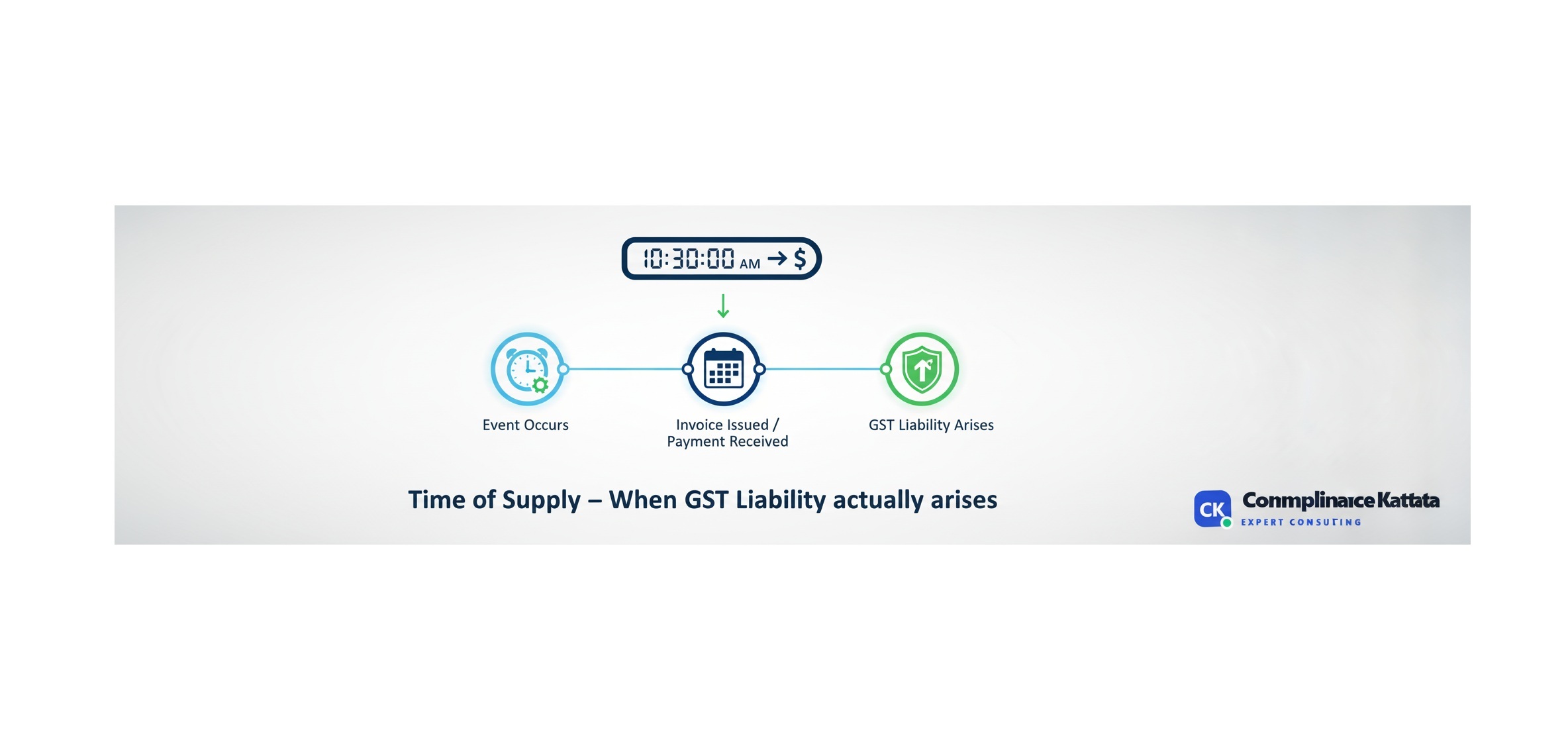
Time of Supply: Unraveling When Your GST Liability Kicks In
For businesses operating under the Goods and Services Tax (GST) regime, understanding the 'Time of Supply' is not just a regulatory formality – it's a cornerstone of effective compliance and cash flow management. It dictates the precise moment a taxable event occurs, thereby triggering your GST liability. Getting this wrong can lead to penalties, interest, and unnecessary compliance headaches.
So, when exactly does your GST liability arise? Let's dive deep into the concept of Time of Supply for both goods and services.
What is Time of Supply?
The 'Time of Supply' is the point in time when goods or services are deemed to have been supplied. This date determines:
- The tax period in which the supply is to be declared.
- The rate of tax applicable (especially if there's a change in rates).
- The due date for payment of tax.
Essentially, it's the trigger point for your obligation to pay GST to the government.
Time of Supply for Goods
The rules for determining the Time of Supply for goods vary depending on the mechanism of tax collection:
1. Forward Charge Mechanism (Normal Supplies)
Under the forward charge mechanism, where the supplier is liable to pay tax, the Time of Supply for goods is the earliest of the following dates:
- Date of issue of invoice by the supplier.
- Last date on which the supplier is required to issue the invoice (as per Section 31 of the CGST Act).
- Date on which the supplier receives the payment (i.e., the date on which the payment is entered in the books of account of the supplier or the date on which the payment is credited to the supplier's bank account, whichever is earlier). However, for goods, the payment date is generally not considered for determining Time of Supply, except for advances received for goods which were taxable until a specific amendment. Currently, advances received for goods are not liable to GST at the time of receipt.
Key takeaway: For most normal supplies of goods, the Time of Supply is primarily linked to the invoice date or the last date for invoice issuance.
2. Reverse Charge Mechanism
In cases where the recipient is liable to pay tax under the reverse charge mechanism, the Time of Supply for goods is the earliest of the following dates:
- Date of receipt of goods.
- Date of payment as entered in the books of account of the recipient or the date on which the payment is debited from his bank account, whichever is earlier.
- Date immediately following 30 days from the date of issue of invoice by the supplier.
If it's not possible to determine the Time of Supply using the above points, then it's the date of entry in the books of account of the recipient.
3. Vouchers
For supply of goods against vouchers:
- If the supply is identifiable at the time of issue of voucher: Date of issue of voucher.
- In all other cases: Date of redemption of voucher.
Time of Supply for Services
The rules for determining the Time of Supply for services also depend on the tax collection mechanism:
1. Forward Charge Mechanism (Normal Supplies)
Under the forward charge mechanism for services, the Time of Supply is determined as follows:
- If the invoice is issued within the prescribed period (generally 30 days from the date of completion of service): The date of issue of invoice or the date of receipt of payment, whichever is earlier.
- If the invoice is not issued within the prescribed period: The date of provision of service or the date of receipt of payment, whichever is earlier.
- In other cases (e.g., continuous supply of services where statement of accounts is issued): The date on which the recipient shows the receipt of services in his books of account.
Key takeaway: For services, both the invoice date/service completion date AND the payment date are crucial for determining Time of Supply.
2. Reverse Charge Mechanism
For services under the reverse charge mechanism, the Time of Supply is the earliest of the following dates:
- Date of payment as entered in the books of account of the recipient or the date on which the payment is debited from his bank account, whichever is earlier.
- Date immediately following 60 days from the date of issue of invoice by the supplier.
If it's not possible to determine the Time of Supply using the above points, then it's the date of entry in the books of account of the recipient.
3. Vouchers
For supply of services against vouchers:
- If the supply is identifiable at the time of issue of voucher: Date of issue of voucher.
- In all other cases: Date of redemption of voucher.
Special Scenarios Affecting Time of Supply
1. Change in Rate of Tax
When there's a change in the GST rate, the Time of Supply becomes critical. The applicable rate depends on whether the supply is completed, invoice issued, and payment received before or after the rate change. Generally, if two of these three events (supply, invoice, payment) occur before the rate change, the old rate applies. If two occur after, the new rate applies.
2. Interest, Late Fee, or Penalty for Delayed Payment
For any interest, late fee, or penalty charged for delayed payment of consideration for a supply, the Time of Supply is the date on which the supplier receives such amount.
3. Continuous Supply of Goods/Services
Specific rules apply for continuous supplies, often linked to periodic statements, payments, or completion of milestones.
Why is Understanding Time of Supply Crucial for Your Business?
- Compliance: Ensures you declare your GST liability in the correct tax period, avoiding discrepancies and notices.
- Cash Flow Management: Helps in planning your tax payments, preventing unexpected cash outflows.
- Penalty Avoidance: Incorrect determination of Time of Supply can lead to late payment of tax, attracting interest and penalties.
- Input Tax Credit (ITC): An accurate Time of Supply helps ensure proper availment and utilization of ITC, as the timing of your liability often impacts when you can claim credit.
Conclusion
The 'Time of Supply' is more than just a theoretical concept; it's a practical determinant of when your GST obligations crystallize. By meticulously tracking invoice dates, payment dates, and service completion dates, businesses can ensure seamless GST compliance, manage their finances effectively, and steer clear of potential penalties. A clear grasp of these rules is indispensable for robust tax planning and operational efficiency in the GST era.
Common Questions
Q.What is the Time of Supply under GST?
The Time of Supply is the point in time when goods or services are deemed to have been supplied, triggering the GST liability. It determines the tax period for declaration, the applicable tax rate, and the due date for tax payment.
Q.How does Time of Supply differ for goods vs. services under the forward charge mechanism?
For goods under forward charge, Time of Supply is primarily linked to the date of invoice issuance or the last date for invoice issuance. For services, it's the earliest of the invoice date (if issued timely) or the date of payment, or the date of provision of service (if invoice is delayed).
Q.What determines the Time of Supply in a Reverse Charge Mechanism (RCM)?
For goods under RCM, it's the earliest of the date of receipt of goods, date of payment, or 30 days from the supplier's invoice date. For services under RCM, it's the earliest of the date of payment or 60 days from the supplier's invoice date.
Q.How does a change in GST tax rate affect the Time of Supply?
When tax rates change, the Time of Supply determines which rate applies. Generally, if two out of three events (supply completion, invoice issuance, payment receipt) occur before the rate change, the old rate applies. If two occur after, the new rate applies.
Q.Why is it important for businesses to accurately determine the Time of Supply?
Accurately determining Time of Supply is crucial for GST compliance, avoiding penalties and interest for late payment, managing cash flow effectively, and ensuring correct declaration of GST liability and proper availment of Input Tax Credit (ITC).