In this article
Introduction & Regulatory Context
The Securities and Exchange Board of India (SEBI), in its continuous endeavor to enhance market efficiency, investor protection, and regulatory oversight, has issued a significant circular aimed at centralizing supplementary Know Your Customer (KYC) data. This move, outlined in Circular No. HO/38/14/(25)2026-MIRSD-POD3 dated November 25, 2026, marks a crucial step towards standardizing and simplifying the KYC process for all market participants. For businesses and SMEs in Pune and across Pan-India, particularly those operating as SEBI-registered intermediaries, understanding and implementing these changes is paramount to ensure seamless compliance and avoid potential regulatory scrutiny.
This circular addresses the long-standing need for a unified repository of client information, moving beyond basic KYC to include critical supplementary details. By centralizing this data at KYC Registration Agencies (KRAs), SEBI aims to reduce duplication of effort, improve data accuracy, and facilitate a more efficient and secure client onboarding experience across the financial ecosystem.
Key Highlights of the SEBI Circular
The latest SEBI circular introduces four concrete action points and key rule changes that intermediaries must integrate into their operational frameworks:
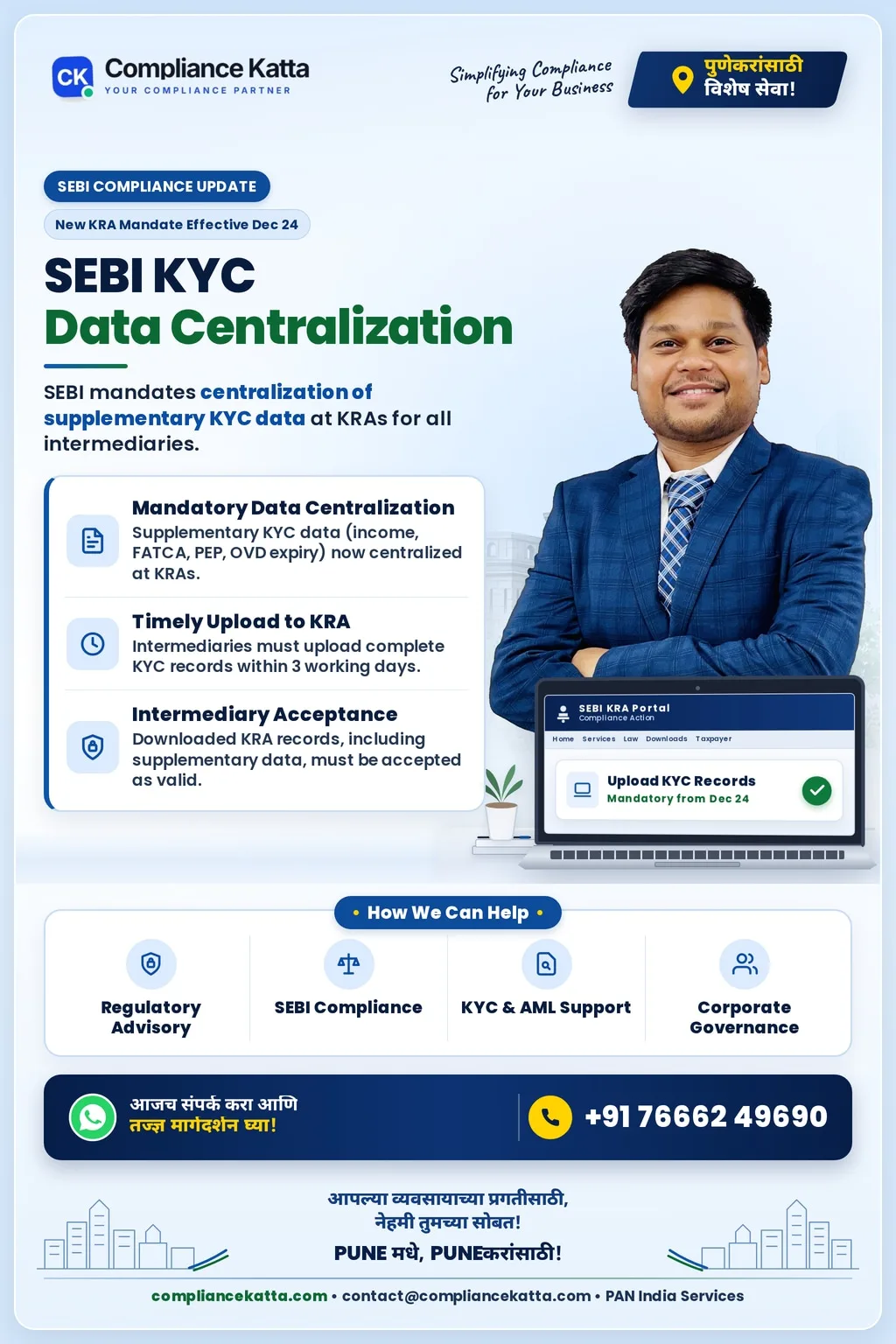
- Mandatory Centralization of Supplementary KYC Information: All supplementary client information, which includes the client's income range (categorized into six prescribed bands), FATCA/CRS (Foreign Account Tax Compliance Act/Common Reporting Standard) details, Politically Exposed Person (PEP) status, occupation, CKYC ID, DIGIPIN, and the expiry date of Officially Valid Documents (OVDs), must now be centralized at the respective KYC Registration Agency (KRA). This ensures a comprehensive and standardized data set for each client.
- Timely Upload to KRA: Intermediaries are now under a strict mandate to upload the complete KYC record, encompassing both basic and the newly centralized supplementary data, to the KRA within three working days of successfully completing the Know Your Customer (KYC) process for a client. This tight deadline emphasizes the need for robust internal processes and efficient data management systems.
- Acceptance of KRA Records by Intermediaries: Any intermediary downloading a client's KYC record from a KRA is now obligated to accept the record, including all supplementary information, as valid. This provision aims to eliminate redundant data collection and verification, fostering greater trust and interoperability within the KRA system.
- KRA Implementation SOPs: KYC Registration Agencies themselves are mandated to issue their detailed implementation Standard Operating Procedures (SOPs) within 30 days from the date of this circular's issuance. These SOPs will provide the necessary technical and procedural guidelines for intermediaries to comply with the new requirements.
Impact on Intermediaries & Investors: A Comparative View
This centralization initiative fundamentally alters how supplementary KYC data is managed and accessed across the Indian financial market. The table below provides a comparative summary of the changes:
| Aspect | Before Circular (HO/38/14/(25)2026-MIRSD-POD3) | After Circular (HO/38/14/(25)2026-MIRSD-POD3) |
|---|---|---|
| Supplementary KYC Data Management | Often fragmented, held by individual intermediaries; varied data points collected. | Mandatory centralization at KRAs, including specific fields like income bands, FATCA/CRS, PEP status, occupation, CKYC ID, DIGIPIN, OVD expiry. |
| KYC Record Upload to KRA | Basic KYC data upload was common; supplementary data upload to KRA was not uniformly mandated or timely. | Complete KYC (basic + supplementary) must be uploaded to KRA within three working days of completion. |
| Intermediary Acceptance of KRA Records | May require re-verification or separate collection of supplementary data by each intermediary. | Intermediaries must accept KRA-downloaded records as valid, including all supplementary information. |
| Legacy Data Handling | No specific mandate for intimating or cleaning up existing supplementary data at KRAs. | Intermediaries must send legacy intimations for existing linked records and zero-balance folios within three months from the circular's issuance. |
For investors, this means a more streamlined experience when opening accounts with multiple intermediaries, as their supplementary KYC data will be readily available and accepted. For intermediaries, it necessitates a significant update to their internal systems and processes to ensure timely and accurate data submission to KRAs.
Compliance Checklist & Deadlines
Adhering to this new SEBI mandate requires proactive steps from all impacted entities. Here’s a compliance checklist with critical deadlines:
- Understand the Scope: Identify all supplementary KYC data points now mandated for centralization (income range, FATCA/CRS, PEP status, occupation, CKYC ID, DIGIPIN, OVD expiry).
- System Upgrades: Ensure your internal systems are capable of capturing, storing, and transmitting these supplementary data points to the KRA in the prescribed format.
- Process Review: Revamp your KYC completion and data upload processes to ensure adherence to the three-working-day upload timeline for all new KYC records.
- KRA SOPs: Monitor for the issuance of detailed implementation SOPs by KRAs (expected within 30 days from November 25, 2026) and integrate their guidelines into your operations.
- Legacy Data Clean-up: For existing linked records and zero-balance folios, initiate the process to send legacy intimations to KRAs within three months from November 25, 2026. Failure to do so will result in stale linkages remaining active in the KRA system.
Key Deadlines:
- Effective Date for New Provisions: Thursday, December 24, 2026 (30 days from circular issuance).
- KRA SOP Issuance: Within 30 days from November 25, 2026.
- Legacy Data Intimation: Within three months from November 25, 2026.
While specific late fees or penalties for non-compliance are not detailed in the circular, non-adherence to SEBI regulations typically attracts stringent regulatory action, including monetary penalties and other enforcement measures. Compliance Katta advises all intermediaries in Pune and Pan-India to prioritize these changes to mitigate compliance risks.
Expert Advice from Compliance Katta: This SEBI circular is a game-changer for KYC compliance. Intermediaries must not only update their data collection mechanisms but also integrate robust automated processes to ensure the three-day upload window is consistently met. Proactive engagement with KRAs and a thorough review of existing client data for legacy clean-up are crucial. Consider this an opportunity to enhance your overall data governance and client service efficiency.
Conclusion
SEBI's mandate for the centralization of supplementary KYC data at KRAs is a progressive step towards a more integrated and efficient financial market. It underscores the regulator's commitment to strengthening the integrity of client data and simplifying compliance for intermediaries. For SEBI-registered entities, particularly SMEs in Pune and across India, this necessitates a comprehensive review and overhaul of their KYC processes, data management systems, and internal controls. Timely compliance will not only prevent regulatory penalties but also foster greater operational efficiency and enhance investor trust.
Disclaimer: This update is for general informational and educational purposes only and does not constitute formal legal, tax, or professional advice. Applicability may vary based on specific facts, turnover thresholds, and subsequent notifications. Please consult a qualified professional before acting on this information. For Pune & pan-India compliance assistance, contact Compliance Katta on WhatsApp at +91 76662 49690.
Common Questions
Q.What specific supplementary KYC data points are now mandated for centralization at KRAs?
The SEBI circular mandates the centralization of income range (in six prescribed bands), FATCA/CRS information, Politically Exposed Person (PEP) status, occupation, CKYC ID, DIGIPIN, and the expiry date of Officially Valid Documents (OVDs) at KYC Registration Agencies (KRAs).
Q.What is the deadline for intermediaries to upload complete KYC records, including supplementary data, to KRAs?
Intermediaries are required to upload the complete KYC record, encompassing both basic and the newly centralized supplementary data, to the KRA within three working days of completing the Know Your Customer (KYC) process for a client.
Q.How does this circular impact existing client records and zero-balance folios?
For existing linked records and zero-balance folios, intermediaries must send legacy intimations to KRAs within three months from the circular's issuance date (November 25, 2026). Failure to do so will result in these stale linkages remaining active in the KRA system.
Q.What are the implications for intermediaries when downloading a client's KYC record from a KRA?
Any intermediary downloading a client's KYC record from a KRA is now mandated to accept the record, including all supplementary information, as valid. This aims to reduce redundant data collection and verification efforts across different intermediaries.
Q.What are the potential consequences of non-compliance with this SEBI circular?
While the circular does not detail specific late fees or penalties, non-adherence to SEBI regulations typically attracts stringent regulatory action. This can include monetary penalties, suspension of operations, or other enforcement measures as deemed appropriate by the regulator.