In this article
Introduction & Regulatory Context
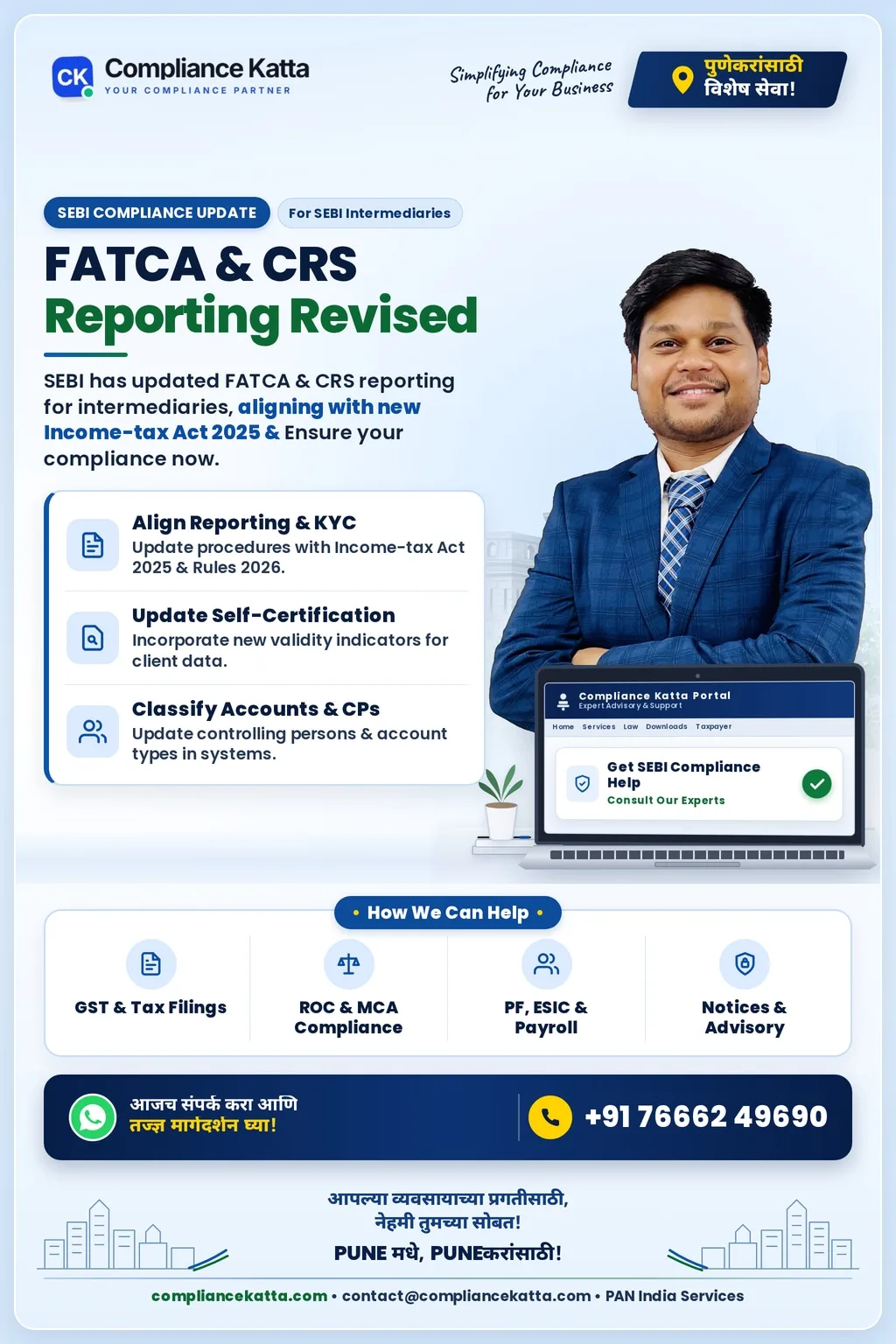
The Securities and Exchange Board of India (SEBI) has taken a significant step to bolster the integrity and transparency of India's financial markets by issuing revised guidelines for Foreign Account Tax Compliance Act (FATCA) and Common Reporting Standard (CRS) compliance. This pivotal update, communicated via SEBI Circular No. HO/38/14/(18)2026-MIRSD-POD2/I/25560/2026 dated November 11, 2026, directly impacts all SEBI-registered intermediaries operating across Pune and Pan-India. The revisions are a direct consequence of the recently implemented Income-tax Act, 2025, and the Income-tax Rules, 2026, which came into effect on April 1, 2026, necessitating a comprehensive alignment of existing compliance frameworks.
FATCA and CRS are international tax compliance regimes designed to combat tax evasion by facilitating the automatic exchange of financial account information between participating jurisdictions. For SEBI-registered entities, adherence to these standards is not merely a regulatory obligation but a critical component of maintaining trust and transparency within the global financial ecosystem. Compliance Katta emphasizes that these revised guidelines require immediate attention and proactive measures from all affected intermediaries to ensure seamless transition and avoid potential penalties.
Key Highlights & Statutory Changes
The new SEBI circular introduces several critical changes that demand immediate action from Reporting Financial Institutions (RFIs). These changes are designed to integrate the updated provisions of the Income-tax Act, 2025, and Income-tax Rules, 2026, into the operational fabric of SEBI-registered intermediaries. The primary objective is to enhance the accuracy and completeness of financial information reported to tax authorities, thereby strengthening India's commitment to international tax transparency standards.
- Alignment with New Tax Laws: Intermediaries must now align their entire reporting ecosystem, including customer onboarding, Know Your Customer (KYC) frameworks, and ongoing reporting procedures, with the specific provisions outlined in the Income-tax Act, 2025, and Income-tax Rules, 2026.
- Enhanced Self-Certification Procedures: A key change involves updating self-certification procedures to incorporate a new 'validity indicator'. This ensures that the information provided by clients, especially Non-Resident Indians (NRIs), trusts, and entities with foreign links, remains current and accurate for FATCA/CRS purposes.
- Granular Account Classification: Systems must be updated to accurately reflect the roles of 'controlling persons' (such as settlor, trustee, protector, beneficiary, or other) and to classify 'account types' (e.g., individual, entity) and their 'pre-existing/new status'. This level of detail is crucial for precise reporting.
- Software & Data Upload Mandate: Reporting Financial Institutions are now required to update their Form 166 XML software to include all new mandatory fields. Furthermore, all FATCA and CRS certifications obtained from clients must be uploaded to the respective KYC Registration Agencies (KRAs).
Practical Compliance Checklist
For SEBI-registered intermediaries, including brokers, portfolio managers, and Alternative Investment Fund (AIF) managers, navigating these changes requires a structured approach. Compliance Katta recommends the following practical steps:
- Review & Update Internal Policies: Conduct a thorough review of existing FATCA/CRS policies, procedures, and internal controls. Update them to reflect the new requirements of the Income-tax Act, 2025, and Income-tax Rules, 2026.
- System Upgrades: Prioritize the upgrade of IT systems, particularly the Form 166 XML software, to accommodate all new mandatory fields for reporting. Ensure seamless integration with existing customer relationship management (CRM) and KYC systems.
- Client Communication & Re-certification: Develop a clear communication strategy for clients, especially NRIs and entities with foreign connections, regarding the updated self-certification requirements. Implement a process for obtaining and validating new self-certifications with the required validity indicator.
- Training & Awareness: Conduct comprehensive training sessions for all relevant staff, including compliance, operations, and client-facing teams, on the revised guidelines, updated procedures, and the implications of non-compliance.
- Data Management & Upload: Establish robust data management protocols to ensure accurate collection, storage, and timely upload of all FATCA and CRS certifications to KYC Registration Agencies (KRAs).
- Internal Audit & Review: Implement a periodic internal audit mechanism to assess ongoing compliance with the revised FATCA/CRS guidelines and identify any gaps or areas for improvement.
Expert Advice from Compliance Katta:
The revised SEBI guidelines for FATCA and CRS compliance are not merely procedural tweaks; they represent a fundamental shift towards more granular and accurate reporting. For our clients in Pune and across India, proactive engagement with these changes is paramount. We strongly advise intermediaries to conduct a comprehensive gap analysis of their current systems and processes against the new requirements. Engaging with compliance experts can streamline this transition, ensuring that your firm remains fully compliant and avoids the significant risks associated with non-adherence. Our team is equipped to provide tailored advisory and implementation support.
Deadlines & Penalties
The SEBI circular, issued on November 11, 2026, directs intermediaries to take the necessary steps for compliance without specifying a new, immediate deadline for the implementation of these specific revisions. However, the underlying Income-tax Act, 2025, and Income-tax Rules, 2026, which form the basis of these revisions, came into effect on April 1, 2026. This implies that intermediaries are expected to have been working towards alignment since that date, and the SEBI circular serves as a directive to finalize and formalize these efforts.
While specific new penalty figures for this circular are not detailed, non-compliance with SEBI regulations can lead to severe administrative and monetary penalties. The SEBI (Settlement of Administrative and Civil Proceedings) Regulations, 2026, which came into effect on November 7, 2026, provide the framework for such actions. These regulations empower SEBI to impose significant fines, issue directives, or even suspend operations for non-compliant entities. Therefore, timely and accurate compliance is not just a best practice but a critical safeguard against regulatory enforcement actions.
Conclusion
The revised FATCA and CRS reporting requirements issued by SEBI underscore India's commitment to global tax transparency and financial integrity. For SEBI-registered intermediaries in Pune and Pan-India, this is a call to action to meticulously review, update, and implement robust compliance frameworks. The alignment with the Income-tax Act, 2025, and Income-tax Rules, 2026, necessitates a holistic approach to customer onboarding, data management, and reporting. Compliance Katta stands ready to assist businesses in navigating these complex regulatory landscapes, ensuring seamless adherence and mitigating compliance risks.
Disclaimer: This update is for general informational and educational purposes only and does not constitute formal legal, tax, or professional advice. Applicability may vary based on specific facts, turnover thresholds, and subsequent notifications. Please consult a qualified professional before acting on this information. For Pune & pan-India compliance assistance, contact Compliance Katta on WhatsApp at +91 76662 49690.
Common Questions
Q.What are FATCA and CRS, and why are they important for SEBI intermediaries?
FATCA (Foreign Account Tax Compliance Act) and CRS (Common Reporting Standard) are international frameworks for the automatic exchange of financial account information to combat tax evasion. For SEBI-registered intermediaries, compliance is crucial to ensure transparency, adhere to global standards, and avoid penalties, as they are designated as Reporting Financial Institutions (RFIs).
Q.Who specifically is impacted by these revised SEBI guidelines?
All SEBI-registered intermediaries that qualify as Reporting Financial Institutions (RFIs) are directly impacted. This includes entities such as brokers, portfolio managers, and Alternative Investment Fund (AIF) managers. Additionally, investors, particularly Non-Resident Indians (NRIs), trusts, and entities with foreign links, must ensure their FATCA/CRS self-certification with each intermediary is complete and current.
Q.What are the key changes introduced by SEBI's latest circular?
The key changes include aligning reporting procedures, customer onboarding, and KYC frameworks with the Income-tax Act, 2025, and Income-tax Rules, 2026. Intermediaries must update self-certification procedures with a new validity indicator, accurately classify controlling persons and account types, and update Form 166 XML software for new mandatory fields, uploading certifications to KRAs.
Q.Are there specific deadlines or penalties mentioned for non-compliance with this circular?
The SEBI circular itself, dated November 11, 2026, directs intermediaries to take necessary steps without specifying a new immediate deadline for these specific revisions. However, the underlying Income-tax Act, 2025, and Rules, 2026, came into effect on April 1, 2026. Non-compliance with SEBI regulations can lead to administrative and monetary penalties as per the SEBI (Settlement of Administrative and Civil Proceedings) Regulations, 2026, which became effective on November 7, 2026.
Q.How can Compliance Katta assist SEBI-registered intermediaries with these new FATCA/CRS requirements?
Compliance Katta offers comprehensive advisory and implementation support for SEBI-registered intermediaries in Pune and Pan-India. Our services include conducting gap analyses, assisting with system upgrades, developing client communication strategies, providing staff training, and ensuring accurate data management and reporting to meet the revised FATCA/CRS guidelines and avoid potential penalties.