In this article
Introduction & Regulatory Context
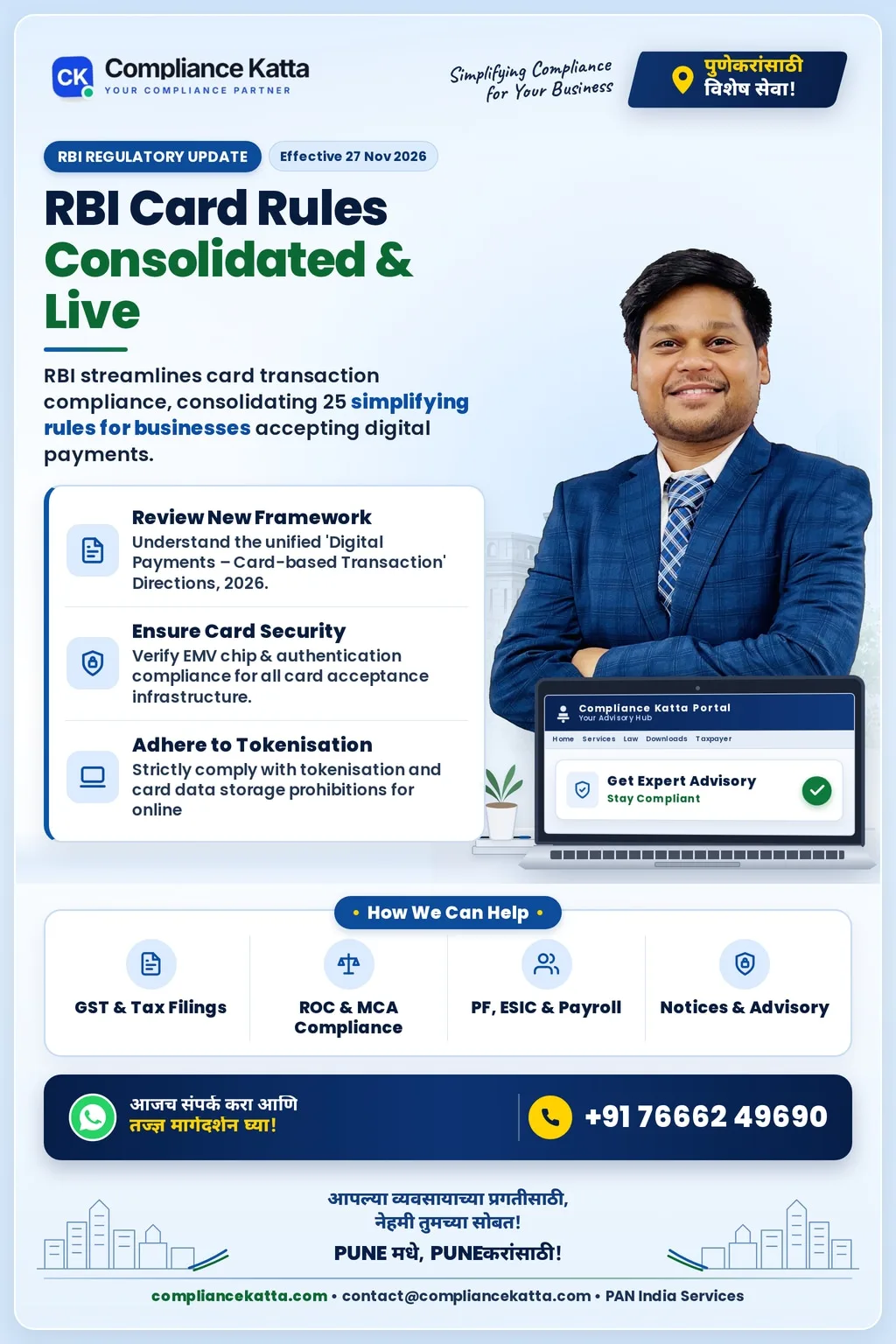
In a significant move towards simplifying and streamlining the regulatory landscape for digital payments, the Reserve Bank of India (RBI) has issued the "Reserve Bank of India (Digital Payments – Card-based Transaction) Directions, 2026." These new directions, notified on November 27, 2026, consolidate a staggering 25 existing circulars pertaining to debit, credit, and prepaid card transactions into a single, comprehensive framework. This consolidation aims to provide greater clarity and ease of compliance for all stakeholders involved in the card payment ecosystem across Pune and Pan-India.
The immediate effect of these directions underscores RBI's commitment to fostering a robust, secure, and efficient digital payment environment while reducing the complexity previously associated with navigating multiple regulatory documents. For Indian SMEs and businesses that rely heavily on accepting card payments, this unified framework represents a crucial update that demands immediate attention.
Key Highlights & Statutory Changes
The core objective of the "Reserve Bank of India (Digital Payments – Card-based Transaction) Directions, 2026" is not to introduce entirely new rules but to integrate and present existing regulations in a more accessible and coherent manner. This consolidation covers a wide spectrum of aspects related to card-based transactions, ensuring that all relevant guidelines are available under one roof.
- Unified Regulatory Framework: The most significant change is the replacement of 25 disparate circulars with a single, comprehensive document. This simplifies the compliance journey for payment system providers and participants.
- Immediate Applicability: The directions came into effect on November 27, 2026, requiring immediate adherence from all impacted entities.
- Retained Core Requirements: Key aspects such as EMV chip card compliance, appropriate authentication methods (PIN/biometric), tokenisation mandates, and prohibitions on storing actual card details by merchants remain firmly in place.
- Focus on Digital Payment Security: The consolidation reinforces RBI's emphasis on secure digital payment practices, ensuring consumer protection and data integrity.
Comparative Summary & Key Requirements
While the new directions consolidate existing rules, understanding the shift from a fragmented to a unified framework is essential. The table below illustrates the primary difference:
| Aspect | Previous Regime (Pre-Nov 27, 2026) | New Regime (Post-Nov 27, 2026) |
|---|---|---|
| Regulatory Structure | 25 separate RBI circulars governing various aspects of card transactions. | Single, consolidated "RBI (Digital Payments – Card-based Transaction) Directions, 2026." |
| Ease of Reference | Required cross-referencing multiple documents for comprehensive compliance. | Simplified, single point of reference for all card-based transaction rules. |
| Core Requirements | EMV chip, tokenisation, authentication, customer controls, etc., were mandated across various circulars. | These core requirements are retained and unified under the new directions. |
| Impacted Entities | Banks, non-bank entities, and merchants had to track multiple updates. | All payment system providers and participants, including banks and non-bank entities, now have one framework. |
The key requirements for businesses accepting card payments remain:
- EMV Chip & PIN Compliance: All Point-of-Sale (PoS) terminals and other card acceptance infrastructure must continue to support EMV chip cards and secure authentication methods like PIN or biometric validation.
- Tokenisation Mandate: Merchants and payment aggregators must strictly adhere to the tokenisation framework, ensuring that actual card details are not stored for online transactions.
- Customer Controls: Businesses should be aware that banks are mandated to provide customers with facilities to activate/deactivate various transaction channels (online, international, contactless) and modify transaction limits. Payment processes should be compatible with these customer-managed settings.
Practical Compliance Checklist for Businesses
For SMEs and businesses in Pune and across India, ensuring compliance with these new consolidated directions is paramount. Here’s a practical checklist:
- Thorough Review: Immediately review the "Reserve Bank of India (Digital Payments – Card-based Transaction) Directions, 2026" (RBI/DPSS/2026-27/477, dated November 27, 2026) to understand the unified regulatory framework.
- Infrastructure Audit: Conduct an internal audit of all card acceptance infrastructure (e.g., PoS terminals, online payment gateways) to confirm continued support for EMV chip cards and appropriate authentication methods (PIN/biometric).
- Tokenisation Adherence: Verify that your online payment processes strictly comply with the tokenisation framework and that no actual card details are stored on your systems. Engage with your payment gateway provider to ensure full compliance.
- Customer Control Compatibility: Ensure your payment processes are compatible with customer-managed card controls (activation/deactivation of channels, transaction limit modifications) provided by banks.
- Internal Training: Educate relevant staff members, especially those involved in payment processing and customer service, about the new consolidated directions and their implications.
Expert Advice from Compliance Katta:While these directions primarily consolidate existing rules, their immediate effect and comprehensive nature mean businesses must not delay in reviewing their current practices. Proactive compliance ensures seamless operations and avoids potential penalties under the Payment and Settlement Systems Act, 2007. Leverage this consolidation as an opportunity to simplify your internal compliance protocols.
Conclusion
The RBI's consolidation of 25 card payment circulars into a single, unified framework marks a significant step towards regulatory clarity and ease of doing business in the digital payments space. For all payment system providers and participants, including banks, non-bank entities, and particularly Indian SMEs accepting card payments, understanding and adhering to the "Reserve Bank of India (Digital Payments – Card-based Transaction) Directions, 2026" is crucial. Compliance Katta advises all businesses in Pune and Pan-India to promptly assess their systems and processes to ensure full alignment with these new, streamlined regulations.
Disclaimer: This update is for general informational and educational purposes only and does not constitute formal legal, tax, or professional advice. Applicability may vary based on specific facts, turnover thresholds, and subsequent notifications. Please consult a qualified professional before acting on this information. For Pune & pan-India compliance assistance, contact Compliance Katta on WhatsApp at +91 76662 49690.
Common Questions
Q.What is the primary purpose of the new RBI (Digital Payments – Card-based Transaction) Directions, 2026?
The primary purpose is to consolidate 25 existing circulars related to debit, credit, and prepaid card transactions into a single, comprehensive regulatory framework. This aims to streamline and simplify compliance requirements for payment system providers and participants, making it easier to navigate the regulatory landscape.
Q.Who is impacted by these new consolidated directions?
These directions impact all payment system providers and participants, including banks and non-bank entities. This broadly affects Indian SMEs and businesses across Pune and Pan-India that accept debit, credit, and prepaid card payments, requiring them to align their processes with the unified framework.
Q.What are the immediate actions businesses need to take regarding these directions?
Businesses should immediately review the new consolidated directions, ensure their card acceptance infrastructure (like PoS terminals) supports EMV chip cards and proper authentication, strictly comply with tokenisation rules, and be aware of customer card controls provided by banks to ensure compatibility with their payment processes.
Q.Do these new directions introduce new penalties or change existing transaction limits?
The notification primarily consolidates existing rules and does not introduce new transaction limits, authentication requirements, or specific penalties within the provided brief. However, non-compliance with RBI directions generally attracts penalties under the Payment and Settlement Systems Act, 2007. Existing Merchant Discount Rate (MDR) ceilings for debit cards also remain unchanged.
Q.What is the effective date of the Reserve Bank of India (Digital Payments – Card-based Transaction) Directions, 2026?
The directions were issued on November 27, 2026, and took effect immediately upon their issuance. This means all impacted entities are expected to be compliant with the consolidated framework from this date onwards.