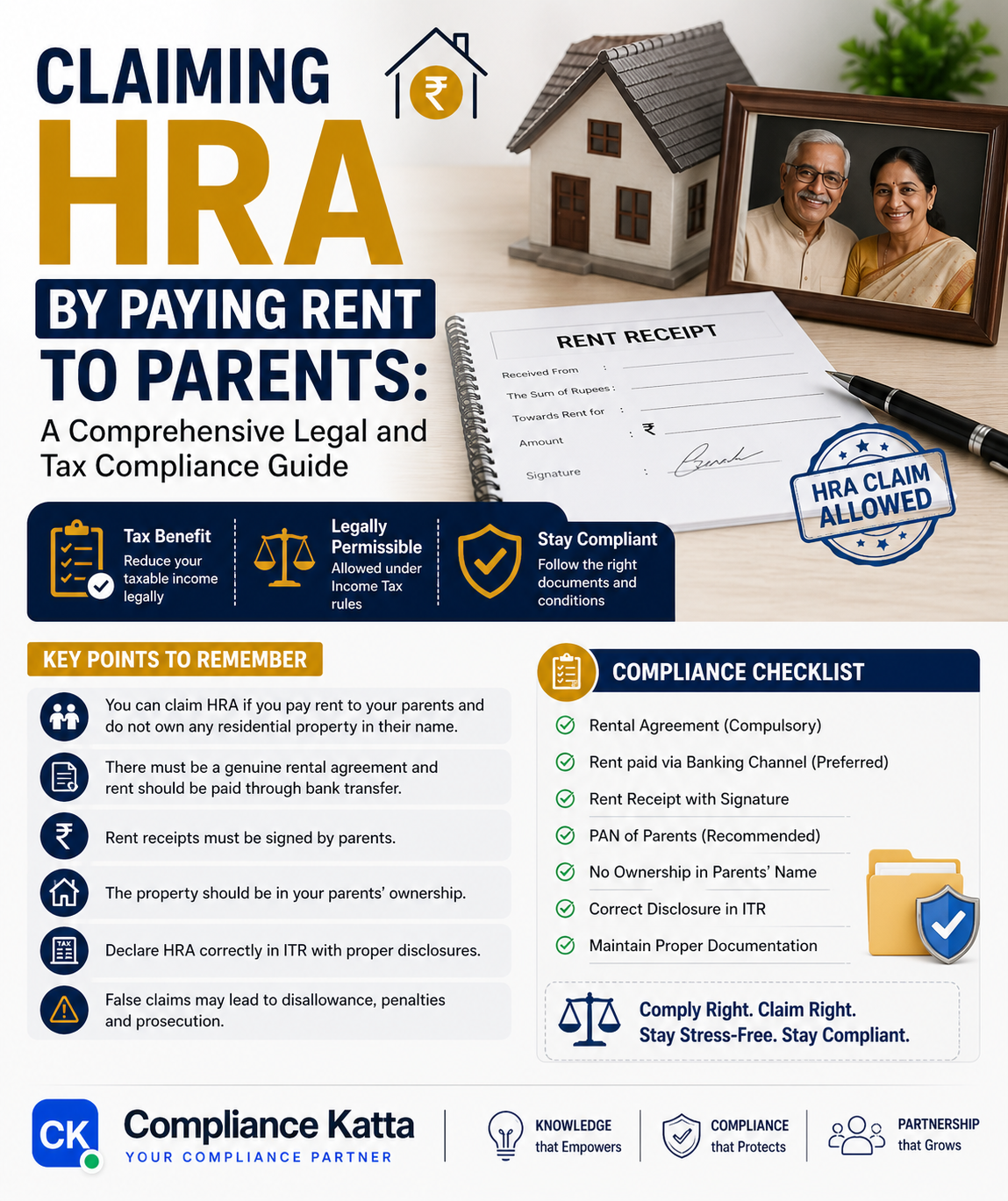
Introduction to HRA Benefits for Residents with Parents
House Rent Allowance (HRA) is a critical component of the salary structure for most salaried professionals in India. Under Section 10(13A) of the Income Tax Act, employees can claim exemptions on HRA to reduce their taxable income. A common query arises when employees live with their parents: Can I pay rent to my parents and claim HRA? The answer is a resounding yes, provided the arrangement is genuine and properly documented. This practice, often dubbed a 'legal tax hack' on social media, is a legitimate tax planning tool when executed with precision and compliance with the law.
Professional Tip: The relationship between the landlord (parent) and the tenant (child) must be commercial in nature. Avoiding cash transactions and maintaining a paper trail is the cornerstone of a successful HRA claim.
Key Highlights of the HRA Rent-to-Parent Strategy
- Legitimacy: The Income Tax Act does not prohibit paying rent to relatives, including parents, as long as the property is owned by them.
- Exemption Calculation: HRA exemption is the minimum of: Actual HRA received, 40%/50% of salary, or Rent paid minus 10% of salary.
- Parental Income: The rent received by parents is taxable under 'Income from House Property' after a standard deduction of 30%.
- Documentation: A formal rent agreement and rent receipts are mandatory to withstand scrutiny by the Income Tax Department.
Impact Analysis: Financial and Legal Implications
Paying rent to parents creates a win-win situation for a family's overall tax liability. While the child reduces their taxable income through HRA, the parent can benefit from the 30% standard deduction available on rental income. If the parent is in a lower tax bracket or falls below the basic exemption limit, the family saves significantly on taxes. However, failure to report this income in the parent’s Income Tax Return (ITR) can lead to 'Benami' transaction allegations or notices under the Prohibition of Benami Property Transactions Act.
Comparison: Living Rent-Free vs. Paying Rent to Parents
| Feature | Living Rent-Free | Paying Rent to Parents |
|---|---|---|
| HRA Exemption | Zero | As per Section 10(13A) |
| Taxable Income (Child) | Higher | Lowered by HRA Exemption |
| Income to Parent | None | Rental Income (Taxable) |
| Standard Deduction | Not Applicable | 30% for Parent |
| Documentation Required | None | Agreement, Receipts, Bank Records |
Structured Flow of the HRA Claim Process
1. Ensure the parent is the legal owner of the property.2. Draft and execute a formal Rent Agreement.3. Set up a monthly bank transfer for rent payment.4. Generate monthly rent receipts signed by the parent.5. Child submits proofs to the employer; Parent declares income in ITR.Compliance Checklist for a Seamless HRA Claim
To avoid notices from the Income Tax department, follow this actionable compliance checklist provided by Compliance Katta:
- Verify Ownership: Ensure the property stands in the name of the parent receiving the rent. If it is jointly owned, the rent should ideally be shared or paid to the specific owner.
- Calculate Optimal Rent: Use a calculator to determine the rent amount that maximizes HRA benefit without creating an undue tax burden for the parent.
- Draft a Formal Rent Agreement: Create a legal document on stamp paper mentioning the rent amount, tenure, and address of the property.
- Ensure Bank Transfers: Always pay rent via NEFT, IMPS, or Cheque. Avoid cash payments to maintain a verifiable audit trail.
- Collect and Store Receipts: Maintain a file of monthly rent receipts containing the landlord's signature and the property details.
- Obtain Parent’s PAN: If the total rent paid exceeds INR 1,00,000 per annum, providing the parent's PAN to your employer is mandatory.
- Declare Income in Parent's ITR: Ensure that the parent files their ITR and reports the rent as 'Income from House Property' to avoid mismatches in Form 26AS.
Conclusion
Claiming HRA by paying rent to parents is a legally sound strategy that optimizes a family's tax outflow. However, the 'hack' only works when treated as a formal business transaction rather than a mere book entry. Compliance is the bridge between tax saving and tax evasion. At Compliance Katta, we emphasize that transparency and documentation are your best defense against tax litigation. For personalized assistance in tax planning and compliance, always consult with experts who understand the nuances of the Indian Income Tax Act.
Common Questions
Q.Can I pay rent to my spouse and claim HRA?
No, the Income Tax Department and various tribunals generally disallow HRA claims for rent paid to a spouse. The logic is that a husband and wife are expected to live together, and such an arrangement is viewed as a sham to evade taxes rather than a genuine commercial tenancy.
Q.Is it mandatory to have a registered rent agreement for HRA?
While a registered agreement is not strictly mandatory for HRA claims under the Income Tax Act for shorter durations, having a written agreement on stamp paper is highly recommended. It serves as primary evidence of a landlord-tenant relationship during an assessment or scrutiny.
Q.What if my parent is a co-owner of the property?
If your parent is a co-owner, you can pay rent to them and claim HRA. However, it is advisable to pay the rent into the bank account of the specific parent who is the legal owner or co-owner. Ensure the rent amount is proportionate to their ownership share if paying to multiple co-owners.
Q.What happens if I pay rent in cash to my parents?
Paying in cash is legally permissible but highly discouraged because it is difficult to prove during a tax audit. To ensure your HRA claim is not rejected, you should ideally use banking channels. If cash is used, ensure you have stamped and signed rent receipts for every single month.
Q.Does my parent have to pay tax on the rent I provide?
Yes, the rent you pay is considered 'Income from House Property' for your parent. They are entitled to a 30% standard deduction for repairs and maintenance, and can also deduct municipal taxes paid. The remaining amount is added to their total income and taxed at their applicable slab rates.