Introduction
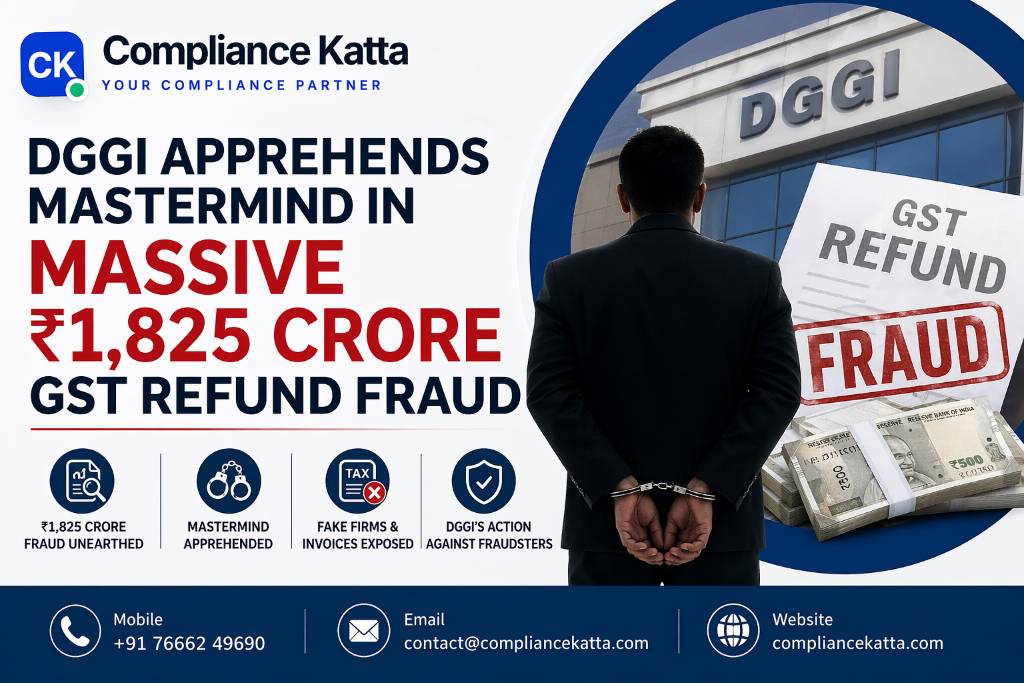
In a major crackdown on tax evasion, the Directorate General of GST Intelligence (DGGI) has successfully apprehended the primary mastermind behind an astronomical ₹1,825 crore GST refund fraud at Delhi Airport. This elaborate syndicate utilized fake invoicing, identity theft, and shell companies to siphon off massive amounts of government revenue. As the regulatory authorities tighten their grip on Input Tax Credit (ITC) and GST refund mechanisms, businesses must stay vigilant and compliant. Compliance Katta brings you an in-depth analysis of this incident and how businesses can protect themselves from falling prey to such fraudulent networks.
Key Highlights of the ₹1,825 Crore GST Fraud
- Massive Scale: The fraudulent operation managed to claim illicit GST refunds amounting to ₹1,825 crore through a highly coordinated identity theft operation.
- Modus Operandi: The perpetrators hijacked the identities of innocent individuals to create a complex web of shell companies, generating fake invoices without any actual supply of goods or services.
- Arrest at Delhi Airport: The mastermind was intercepted and arrested by the DGGI at Delhi Airport while attempting to flee or manage the illicit operations.
- Zero Actual Supply: The entire chain of Input Tax Credit (ITC) was established strictly on paper, completely bypassing the physical movement of goods.
- Advanced Analytics Used: The DGGI utilized advanced data analytics, artificial intelligence, and physical surveillance to track the money trail and trace the real beneficiaries.
Impact Analysis: What This Means for Businesses
The uncovering of this massive ₹1,825 crore GST refund fraud will have profound implications for the Indian business landscape. The GST department is expected to escalate its scrutiny of ITC claims, particularly those involving high-value refunds and zero-rated supplies. Honest taxpayers may face increased procedural checks, delayed refund processing, and rigorous physical verifications of their registered premises. Furthermore, associating with any vendor unknowingly involved in such a fake invoicing syndicate can lead to severe penal actions, reversal of ITC, and blocked electronic credit ledgers. It is imperative that corporate entities maintain an unblemished compliance record to navigate this enhanced regulatory oversight successfully.
Comparison: Genuine vs. Fraudulent GST Practices
| Parameters | Genuine Business Practices | Fraudulent Syndicates (Shell Entities) |
|---|---|---|
| Invoice Generation | Backed by verified e-way bills and actual physical movement of goods. | Fake invoices generated solely to pass on ITC without any goods. |
| Business Premises | Verifiable, active, and matching the GST portal records upon inspection. | Fictitious addresses, often locked or non-existent upon physical verification. |
| Identity Usage | Authorized directors and promoters with transparent and legitimate KYC. | Identity theft, utilizing credentials of daily wage workers or unaware citizens. |
| Financial Transactions | Payments routed through legitimate banking channels matching actual supplies. | Circular trading with funds rapidly routed to disguise the origin and destination. |
Professional Tip: Always secure your GST registration credentials and regularly monitor your GSTR-2B. If you spot unfamiliar invoices, report them immediately to the jurisdictional officer to prevent accusations of complicity in fake ITC chains.
Actionable Compliance Checklist
To shield your business from the cascading effects of fake invoicing and enhanced DGGI scrutiny, follow this rigorous compliance checklist:
- Verify Vendor Authenticity: Conduct thorough background checks and physical verification of the principal place of business for new vendors before entering into high-value contracts.
- Validate E-way Bills: Ensure that every invoice claiming ITC is strictly backed by a corresponding e-way bill and goods receipt note (GRN).
- Reconcile ITC Regularly: Calculate and match your GSTR-2B with your purchase register monthly, ensuring you flag and investigate any mismatched or missing entries.
- Conduct Periodic KYC: Implement a robust Know Your Vendor (KYV) policy, requiring updated GST registration certificates, PAN, and Aadhaar of authorized signatories annually.
- Maintain Detailed Documentation: Preserve all transportation receipts, weighbridge slips, and toll receipts to substantiate the actual movement of goods in case of departmental audits.
- Audit Payment Channels: Ensure all vendor payments are made strictly through banking channels within the 180-day stipulated timeframe under GST laws.
Process Flow: Steps to Ensure Vendor GST Authenticity
- Step 1: Onboarding - Collect GSTIN, PAN, and canceled cheque from the vendor before initiating business.
- Step 2: Portal Verification - Check the GSTIN status (Active/Inactive) and return filing compliance history on the official GST portal.
- Step 3: Physical Verification - Request geocoded photographs or conduct a site visit for large-scale suppliers to confirm business existence.
- Step 4: Agreement Execution - Include strict indemnity clauses against GST defaults or fake invoicing in the commercial vendor contract.
- Step 5: Continuous Monitoring - Track the vendor's GSTR-1 and GSTR-3B filing status monthly before releasing full payments.
Conclusion
The DGGI's successful operation at Delhi Airport serves as a stern warning against the misuse of the GST framework. While the government continues to leverage technology to weed out bad actors, businesses must proactively adopt stringent vendor compliance protocols. Ignorance is not a defense in the eyes of tax authorities when it comes to fraudulent ITC claims. By maintaining transparent operations and rigorous KYC standards, businesses can ensure uninterrupted growth and compliance. For expert guidance on GST audits, risk mitigation, and vendor reconciliation, partner with Compliance Katta, your trusted compliance ally.
Common Questions
Q.What is fake invoicing in GST?
Fake invoicing refers to the issuance of GST invoices without the actual supply of goods or services. It is primarily done to fraudulently pass on Input Tax Credit (ITC) to other entities, resulting in a massive revenue loss to the government exchequer.
Q.How does the DGGI track GST refund frauds?
The Directorate General of GST Intelligence (DGGI) utilizes advanced data analytics, artificial intelligence, and network visualization tools to track mismatches in GSTR-1, GSTR-3B, and e-way bills. They also monitor circular trading patterns and suspicious banking transactions to pinpoint the masterminds.
Q.What happens if a business unknowingly claims ITC from a fake vendor?
If a business claims ITC from a vendor subsequently identified as a fake entity, the GST department can demand the reversal of the claimed ITC along with applicable interest and penalties. The burden of proof lies heavily on the recipient to prove the actual receipt of goods or services through robust documentation.
Q.How can businesses protect themselves from fraudulent vendors?
Businesses can protect themselves by implementing a strict Know Your Vendor (KYV) policy and verifying the GSTIN status on the official portal before onboarding. Ensuring that all transactions are backed by robust documentation such as e-way bills, transport receipts, and banking payment proofs is also crucial.
Q.What are the penalties for orchestrating a GST fraud of this magnitude?
Under the CGST Act, 2017, offenses involving tax evasion or fake ITC exceeding ₹5 crore are classified as non-bailable and cognizable offenses. The perpetrators face severe financial penalties and imprisonment extending up to 5 years, along with the immediate attachment of bank accounts and properties.