Introduction & Regulatory Context
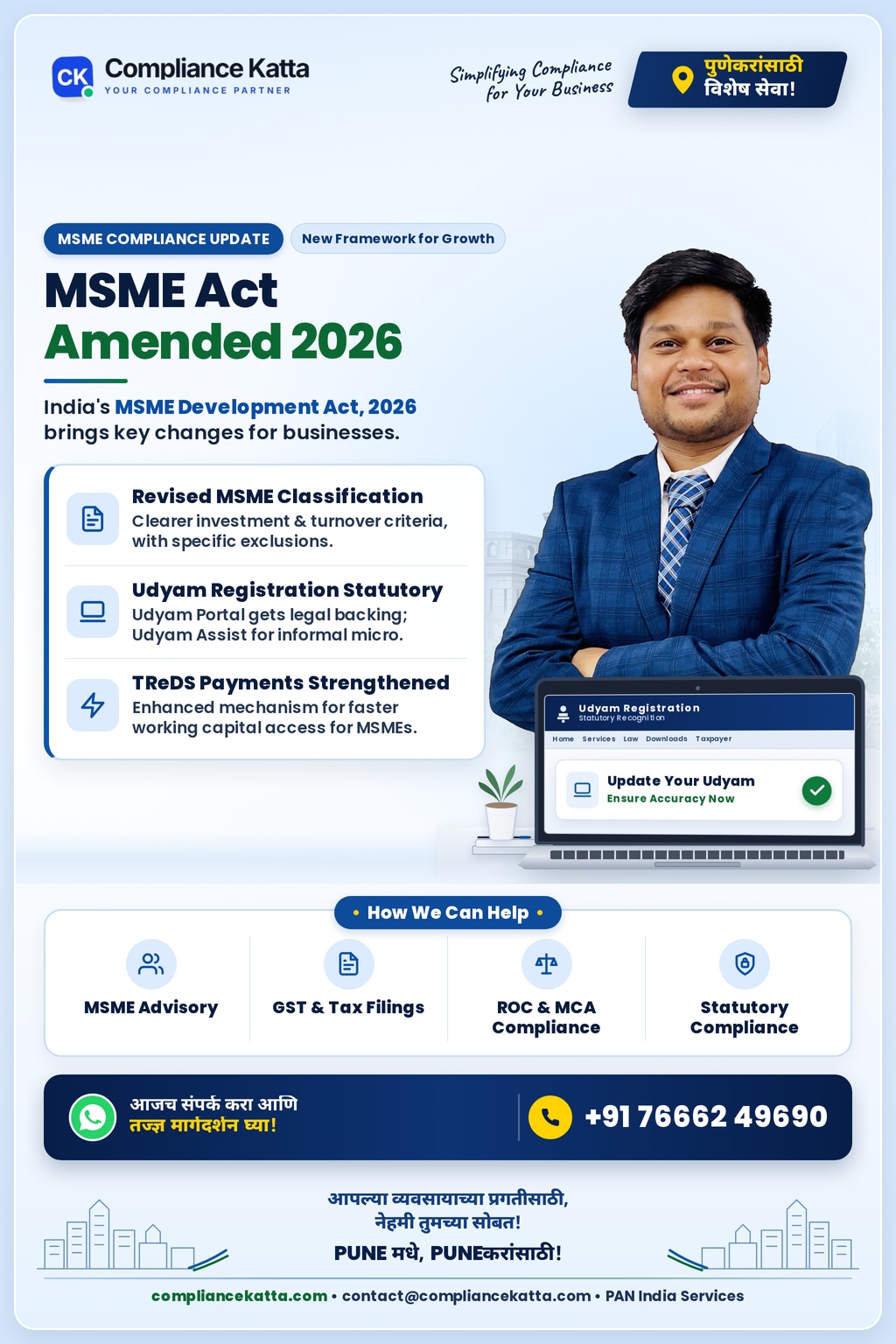
The Micro, Small and Medium Enterprises Development (Amendment) Act, 2026 represents a structural overhaul of India's statutory framework governing micro, small, and medium enterprises. Enacted by Parliament in August 2026 (receiving Presidential assent on August 13, 2026) and actively shaping compliance workflows through late 2026, the law addresses long-standing bottlenecks in MSME classification, digital formalization, delayed payment liquidity, and Facilitation Council dispute timelines.
Whether you operate a manufacturing MSME in Pune's industrial belt or run a mid-to-large corporate enterprise procuring goods and services from registered MSME suppliers across India, these statutory amendments reshape vendor classification, procurement compliance, and accounts payable governance.
Key Highlights & Statutory Changes
The Amendment Act, 2026 introduces four foundational pillars designed to promote ease of doing business while tightening payment accountability:
- Flexible Dual-Threshold Classification Framework: Moves beyond static legacy ceilings by empowering the Central Government to prescribe dynamic composite thresholds combining investment in plant, machinery, or equipment and annual turnover.
- Targeted Investment Exclusions: Specifically safeguards growth-oriented capital spending by allowing prescribed exclusions when computing investment limits—such as capital outlays toward environmental protection, pollution control, in-house R&D, and industrial safety equipment.
- Voluntary Digital Registration & Portal Integration: Streamlines MSME memorandum/registration as a friction-free voluntary digital framework backed by centralized national infrastructure (integrated with tax and GSTN data systems) alongside complementary state portals.
- Mandatory TReDS Settlement for CPSEs: Requires Central Public Sector Enterprises (CPSEs) to settle eligible MSME supplier invoices through the RBI-regulated Trade Receivables Discounting System (TReDS), unlocking faster working capital and empowering Central and State Governments to extend similar obligations to other public entities.
Comparative Overview: Prior Framework vs. 2026 Amendment
The summary table below highlights the operational shifts introduced under the MSME Development (Amendment) Act, 2026 compared to traditional statutory processes:
| Compliance Area | Earlier Approach | MSME Amendment Act, 2026 Framework |
|---|---|---|
| Classification Criteria | Rigid statutory ceilings with limited flexibility | Dynamic composite rules balancing investment & annual turnover |
| Capital Exclusions | Standard plant & machinery cost aggregation | Prescribed exclusions for R&D, pollution control & safety equipment |
| Registration & Formalization | Manual / fragmented administrative touchpoints | Voluntary centralized digital registration integrated with GSTN & tax records |
| TReDS & Buyer Payments | Voluntary adoption for most public-sector buyers | Mandatory TReDS settlement for CPSEs, with broader government enabling powers |
| Dispute Resolution | Overburdened Council queues and slower resolution | Streamlined Micro & Small Enterprises Facilitation Council timelines & mediation |
Compliance Checklist & Impact for Businesses
Expert Advice from Compliance Katta: Do not treat the 2026 MSME amendments as purely an MSME registration update. Corporate buyers, CFOs, and procurement teams must verify MSME vendor status, segregate qualifying pollution/R&D/safety capex schedules before fiscal close, and audit payment cycles to prevent compliance exposure and interest disputes.
- Re-Verify Enterprise Classification: Audit current investment in plant and machinery alongside annual turnover, separating qualifying R&D, safety, and environmental compliance capital expenditures under applicable rules.
- Ensure Clean Digital MSME Documentation: Keep enterprise PAN, GSTIN, turnover declarations, and MSME portal details synchronized to maintain seamless digital verification with institutional lenders and buyers.
- Evaluate TReDS Onboarding & Receivables Flow: MSMEs supplying government bodies or CPSEs should maintain active TReDS onboarding to accelerate invoice discounting and safeguard working capital.
- Audit Corporate Accounts Payable Aging: Buyers procuring from micro and small enterprises should track invoice due dates rigorously and align vendor master data with verified MSME certificates.
- Monitor Implementing Notifications: Track subsequent Ministry rules and circulars for threshold fine-tuning, portal migration procedures, and Facilitation Council conciliation norms.
Conclusion
The MSME Development (Amendment) Act, 2026 establishes a modernized compliance foundation focused on digital transparency, sustainable industrial capex protection, and reliable receivable liquidity. Both growing MSMEs and large enterprise buyers in Pune and Pan-India benefit from aligning their ERP classification, GST/income-tax data consistency, and TReDS receivables workflows early.
For tailored support on MSME classification audits, Udyam documentation, GST/Income Tax reconciliation, and statutory compliance advisory, reach out to Compliance Katta on WhatsApp at +91 76662 49690.
Disclaimer: This update is for general informational and educational purposes only and does not constitute formal legal, tax, or professional advice. Applicability may vary based on specific facts, turnover thresholds, and subsequent notifications. Please consult a qualified professional before acting on this information. For Pune & pan-India compliance assistance, contact Compliance Katta on WhatsApp at +91 76662 49690.
Common Questions
Q.When was the MSME Development (Amendment) Act, 2026 enacted?
After being passed by the Rajya Sabha and Lok Sabha in early August 2026, the MSME Development (Amendment) Act, 2026 received Presidential assent on August 13, 2026, introducing structural updates to classification, digital registration, payment security, and dispute resolution.
Q.How does the 2026 Amendment change MSME classification thresholds?
It empowers the Central Government to administer flexible composite criteria combining investment in plant and machinery or equipment with annual turnover, while excluding certain sustainability, pollution control, industrial safety, and R&D investments from threshold calculations.
Q.Is digital MSME registration mandatory under the amended Act?
Filing an MSME registration/memorandum under the framework remains voluntary and digital, supported by a centralized portal integrated with databases such as GSTN and income tax systems alongside complementary state-level portals.
Q.What does the Act mandate regarding TReDS payments?
To curb delayed payments, the Act requires every Central Public Sector Enterprise (CPSE) to settle invoices for goods and services procured from MSMEs through TReDS, and empowers central and state governments to direct similar public authorities to adopt the platform.
Q.How can Compliance Katta help MSMEs and corporate buyers prepare?
Compliance Katta assists MSMEs and corporate finance teams in Pune and across India with MSME eligibility reviews, digital Udyam alignment, GST/TDS/Income Tax data reconciliation, and accounts payable compliance workflows.