Introduction
In the evolving landscape of Indian taxation, the introduction of Section 43B(h) of the Income Tax Act has sent shockwaves through the business community. Aimed at bolstering the liquidity of Micro and Small Enterprises (MSMEs), this provision mandates that payments to these entities must be made within specific timelines. Failure to do so doesn't just attract interest; it leads to the total disallowance of the expense for that financial year, resulting in a significant increase in tax liability. For businesses looking to optimize their tax outflows, understanding this rule is no longer optional—it is a survival necessity. Compliance Katta brings you this deep-dive analysis to help you navigate these regulatory waters.
Understanding Section 43B(h) and the MSMED Act
Section 43B of the Income Tax Act traditionally lists expenses that are deductible only on an actual payment basis. With the Finance Act 2023, clause (h) was added, specifically targeting payments owed to Micro and Small enterprises. This clause links directly to Section 15 of the MSMED Act, 2006, which dictates the payment cycle.
Key Highlights of the Provision
- Applicability: It applies only to payments made to 'Micro' and 'Small' enterprises registered under the Udyam portal.
- Exclusion: Medium enterprises are currently outside the purview of Section 43B(h).
- The 15-Day Rule: In the absence of a written agreement, payment must be made within 15 days from the date of acceptance of goods or services.
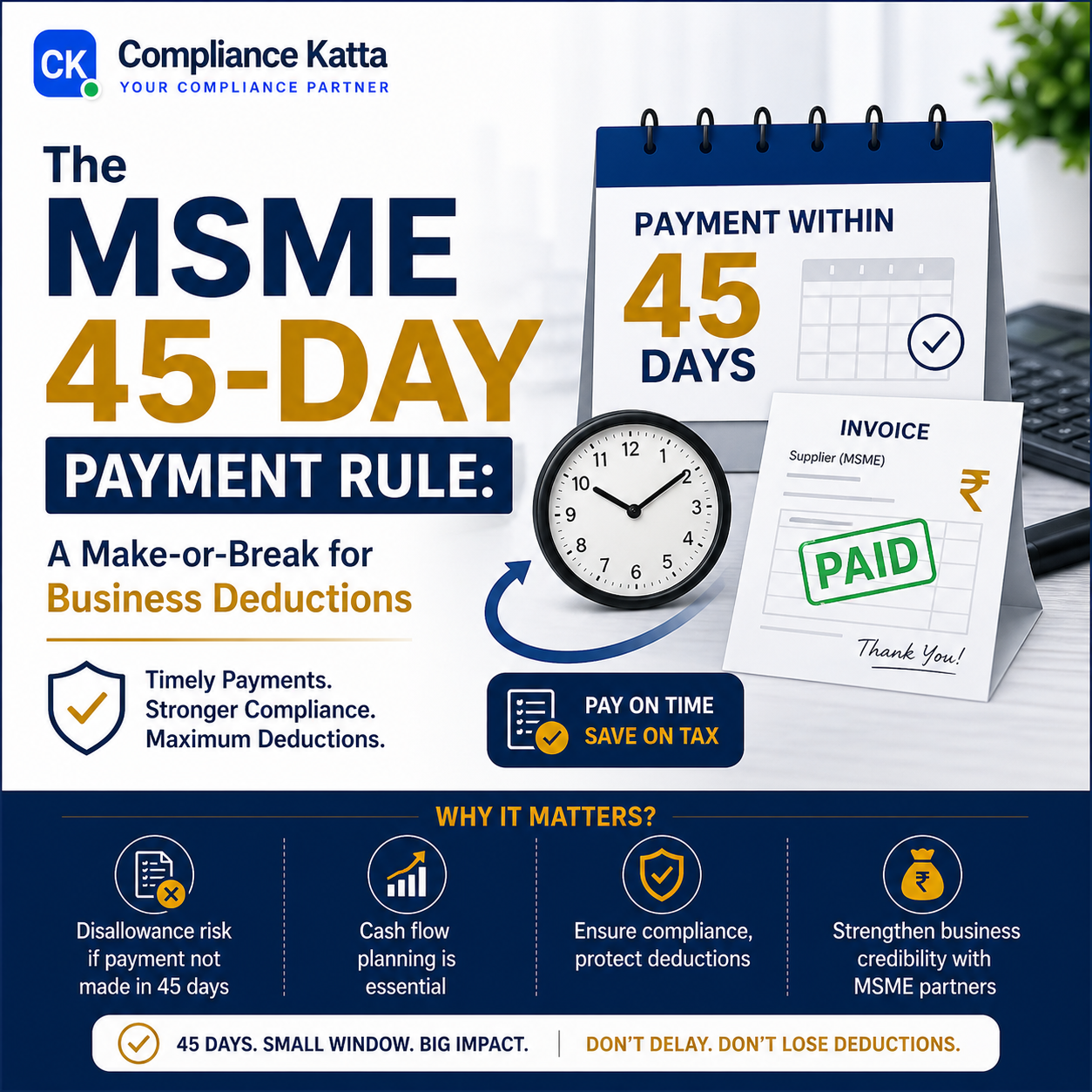
- The 45-Day Rule: If a written agreement exists, the payment period cannot exceed 45 days from the date of acceptance.
- Disallowance Impact: If payment is not made within these timelines, the deduction for that expense will be disallowed in the year of accrual and only allowed in the year of actual payment.
Professional Tip: Even if you pay before filing your Income Tax Return but after the 15/45-day window, the deduction is still disallowed for the current financial year if the payment crossed the March 31st threshold.
Impact Analysis: The Financial Consequences
The primary impact is a 'timing difference' that can severely hurt a company's cash flow. If a business has outstanding dues to MSMEs as of March 31st that have exceeded the 45-day limit, those expenses are added back to the taxable income. This could potentially increase the tax bill by 25% to 30% of the disallowed amount.
| Enterprise Category | Investment in Plant & Machinery | Annual Turnover | Covered under 43B(h)? |
|---|---|---|---|
| Micro Enterprise | ≤ ₹1 Crore | ≤ ₹5 Crore | Yes |
| Small Enterprise | ≤ ₹10 Crore | ≤ ₹50 Crore | Yes |
| Medium Enterprise | ≤ ₹50 Crore | ≤ ₹250 Crore | No |
Operational Flow: How the Rule Triggers
- Purchase from MSME: Invoice generated and goods/services received.
- Verification: Check if the vendor is a Micro or Small enterprise via Udyam Certificate.
- Agreement Check: Does a written contract exist specifying a credit period?
- Timeline Monitoring: Ensure payment is released within 15 days (No Agreement) or 45 days (With Agreement).
- Year-End Action: Any unpaid dues exceeding these limits by March 31st must be flagged for tax disallowance.
The Compliance Checklist for Businesses
To avoid unexpected tax hits, businesses must adopt a proactive stance. Use the following checklist developed by Compliance Katta:
- Verify Vendor Status: Request all vendors to provide their latest Udyam Registration Certificate. Categorize them into Micro, Small, or Medium.
- Update Vendor Master Data: Clearly mark MSME vendors in your ERP or accounting software with their respective category and payment deadlines.
- Review Purchase Agreements: Ensure written contracts are in place for all MSME vendors to avail the full 45-day credit period instead of the default 15 days.
- Automate Alerts: Set up automated reminders in your accounting system for invoices reaching the 30-day and 40-day mark.
- Calculate Potential Exposure: Before the end of the financial year, run an aging report specifically for Micro and Small enterprises to identify overdue payments.
- Obtain Declarations: For vendors not registered under MSME, obtain a formal declaration to ensure clarity during tax audits.
Conclusion
The Section 43B(h) mandate is a double-edged sword. While it protects the interests of smaller suppliers by ensuring timely liquidity, it imposes a heavy administrative and financial burden on buyers. Navigating this requires a blend of accounting precision and legal clarity. By systematically identifying MSME vendors and aligning payment cycles, businesses can ensure they don't lose out on critical tax deductions. Compliance Katta remains your partner in ensuring that your business remains compliant while optimizing its financial health. Remember, in the world of compliance, a stitch in time—or a payment in 45 days—saves nine.
Common Questions
Q.Does Section 43B(h) apply to payments made to traders?
Generally, Section 43B(h) applies to 'enterprises' as defined under the MSMED Act, which primarily covers manufacturers and service providers. While traders can register on the Udyam portal for certain benefits like Priority Sector Lending, current interpretations suggest they may not fall under the 'enterprise' definition for the purposes of Section 43B(h) disallowances unless they are also engaged in manufacturing or services. It is recommended to consult with Compliance Katta for specific case-by-case assessments.
Q.What happens if I pay an MSME vendor after 45 days but within the same financial year?
If you pay after 45 days but still within the same financial year (before March 31st), the deduction is generally allowed in that same financial year. The critical issue arises when the payment is delayed beyond 45 days and remains outstanding as of the end of the financial year. In that case, the deduction is moved to the subsequent year when the payment is actually made.
Q.Is the 45-day limit applicable even if my vendor agrees to a 90-day credit period?
Yes, the law is very clear on this. Section 15 of the MSMED Act overrides any private agreement. Even if you have a written contract for a 90-day credit period, the law recognizes only a maximum of 45 days. Any payment made after 45 days will be considered a delayed payment, attracting penal interest and potential tax disallowance under Section 43B(h).
Q.How is the 'date of acceptance' calculated for the 15/45-day window?
The 'date of acceptance' refers to the day the goods are delivered or services are rendered. If there is a dispute regarding the quality or quantity, the 'date of deemed acceptance' is the date of delivery, unless a formal objection is raised in writing within 15 days. If an objection is raised, the countdown starts from the day the objection is resolved by the supplier.
Q.Does Section 43B(h) apply to businesses under the Presumptive Taxation Scheme?
No, businesses opting for the Presumptive Taxation Scheme under Section 44AD, 44ADA, etc., are generally not affected by Section 43B(h). These schemes involve paying tax on a percentage of turnover regardless of actual expenses or deductions, meaning the specific disallowances under Section 43B do not typically apply to them.