In this article
Introduction & Regulatory Context
The Government of Maharashtra has ushered in a significant change in the state's labour law landscape with the introduction of the Maharashtra Wage Rules, 2026. Notified by the Labour Department under Notification No. COW-0126/C.R.09/Lab-7 on November 5, 2026, these rules came into force immediately, marking a pivotal shift for businesses operating across Pune and pan-India with a presence in Maharashtra. These new rules are framed under the overarching Code on Wages, 2019, and are designed to streamline and modernize wage-related compliance. Crucially, they supersede the erstwhile Maharashtra Minimum Wages Rules, 1963, and the Maharashtra Payment of Wages Rules, 1963, consolidating and updating the regulatory framework for wage administration.
This comprehensive update impacts all employers and HR leaders in Maharashtra, necessitating a thorough review and recalibration of existing payroll and compliance practices. Compliance Katta emphasizes the immediate need for businesses to understand and implement these changes to ensure seamless adherence to the new statutory requirements.
Key Highlights & Statutory Changes
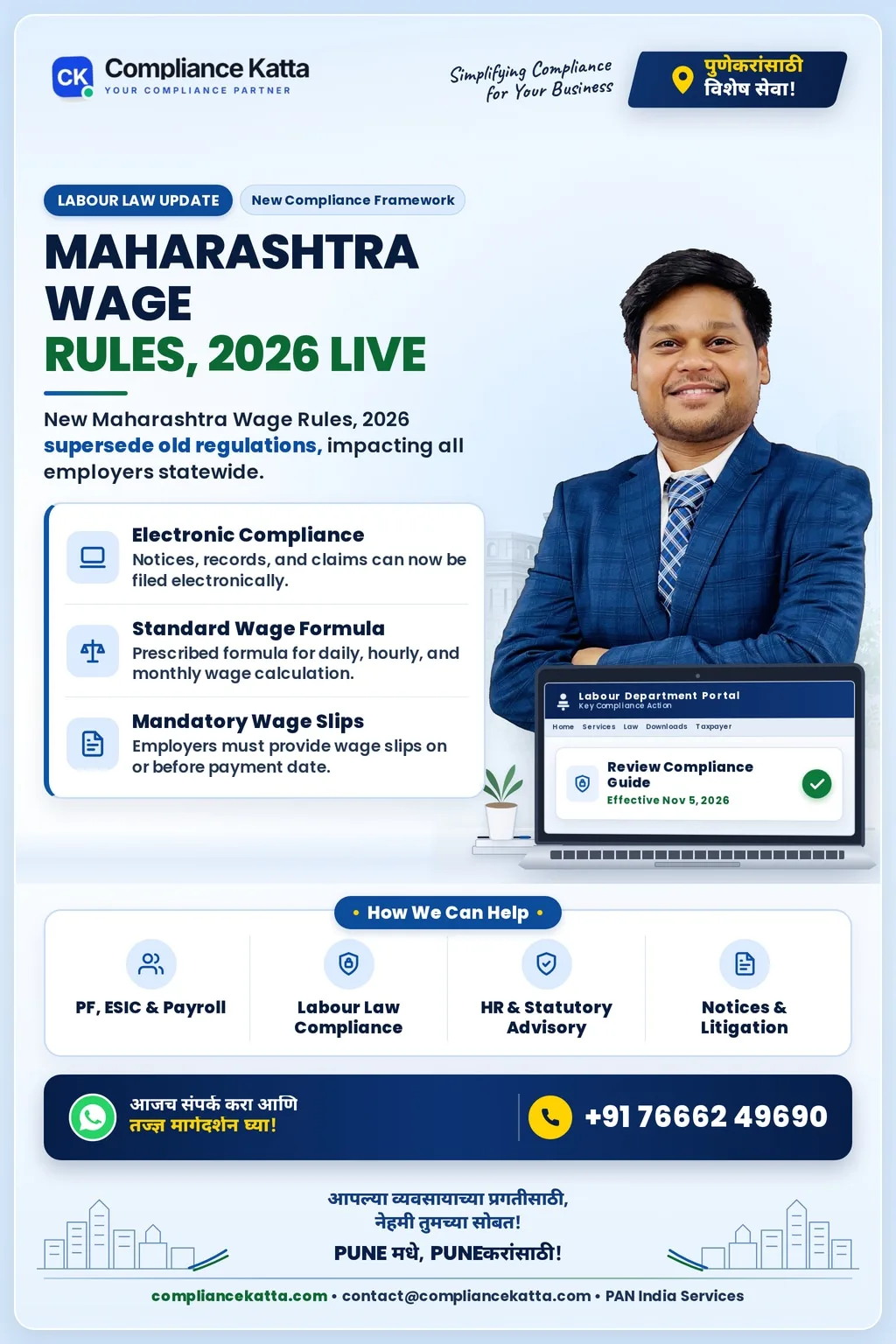
The Maharashtra Wage Rules, 2026, introduce several progressive and impactful changes aimed at enhancing transparency, efficiency, and employee welfare. Here are the four concrete action points and key rule changes:
- Electronic Compliance Permitted: A significant modernization step, employers are now permitted to complete various compliance tasks electronically. This includes the issuance of notices, communications with employees, filing of claims, and the maintenance of statutory records. This move is expected to reduce administrative burden and promote digital record-keeping.
- Uniform Wage Computation Formula: To ensure consistency and clarity, the rules prescribe a standardized formula for wage calculation. Minimum wages are now fixed per day. The hourly wage is derived by dividing the daily wage by 8, and the monthly wage is calculated by multiplying the daily wage by 26. This standardization aims to eliminate ambiguities in wage determination.
- Mandatory Wage Slips: Employers are now under a strict obligation to provide a wage slip to every employee. This must be done on or before the date of payment of wages. This provision enhances transparency for employees regarding their earnings and deductions, promoting fair wage practices.
- Prescribed Registers and Retention: The rules mandate the maintenance of specific registers, which can be in either physical or electronic form. These include registers for employees, wages paid, deductions made, overtime worked, and attendance. Furthermore, employers are required to retain these crucial records for a period of five years, ensuring accountability and facilitating audits.
Comparative Overview: Old vs. New Framework
The new Maharashtra Wage Rules, 2026, represent a significant departure from the previous fragmented regulatory landscape. A quick comparison highlights the modernization and consolidation:
| Aspect | Previous Framework (Pre-Nov 5, 2026) | New Framework (Maharashtra Wage Rules, 2026) |
|---|---|---|
| Governing Rules | Maharashtra Minimum Wages Rules, 1963 & Maharashtra Payment of Wages Rules, 1963 | Maharashtra Wage Rules, 2026 (under Code on Wages, 2019) |
| Compliance Mode | Primarily physical/manual | Electronic compliance permitted for notices, records, claims |
| Wage Calculation | Varied interpretations, less standardized | Uniform formula: Daily wage / 8 (hourly), Daily wage * 26 (monthly) |
| Wage Slips | Often discretionary or less strictly enforced | Mandatory provision of wage slips on or before payment date |
| Record Keeping | Specific registers, retention periods varied | Prescribed registers (employees, wages, deductions, overtime, attendance) to be retained for 5 years |
Practical Compliance Checklist for Employers
To ensure full compliance with the Maharashtra Wage Rules, 2026, employers in Pune and across Maharashtra should undertake the following immediate actions:
- Review and Update Policies: Immediately review and update internal HR and payroll policies to align with the new rules, especially regarding wage computation, wage slip issuance, and record-keeping.
- Implement Electronic Systems: Evaluate and implement systems for electronic maintenance of records, notices, and communications, leveraging the new permission for digital compliance.
- Standardize Wage Calculation: Ensure that all wage calculations strictly adhere to the prescribed uniform formula for daily, hourly, and monthly wages.
- Mandatory Wage Slip Issuance: Establish a robust process to ensure that wage slips are generated and provided to every employee on or before the wage payment date.
- Maintain Statutory Registers: Set up or update the required registers for employees, wages, deductions, overtime, and attendance, ensuring they are maintained for the stipulated five-year retention period.
- Employee Awareness: Conduct awareness sessions for employees and HR staff to educate them about the new rules and their implications.
Expert Advice from Compliance Katta: The immediate enforcement of the Maharashtra Wage Rules, 2026, necessitates a proactive and comprehensive approach from all employers. While specific penalties for non-compliance with these newly introduced rules are not detailed in the brief, non-adherence to labour laws typically attracts significant fines and legal repercussions under the Code on Wages, 2019. We strongly advise businesses to conduct a thorough compliance audit and seek expert guidance to ensure all practices are aligned with the new framework. Timely action will mitigate risks and foster a compliant work environment.
Conclusion & Way Forward
The Maharashtra Wage Rules, 2026, represent a progressive step towards a more standardized, transparent, and digitally-enabled wage administration system in the state. For businesses in Pune and across India with operations in Maharashtra, understanding and implementing these changes is not merely a legal obligation but an opportunity to enhance operational efficiency and foster better employee relations. Compliance Katta stands ready to assist businesses in navigating these new regulations, ensuring a smooth transition and sustained compliance.
Disclaimer: This update is for general informational and educational purposes only and does not constitute formal legal, tax, or professional advice. Applicability may vary based on specific facts, turnover thresholds, and subsequent notifications. Please consult a qualified professional before acting on this information. For Pune & pan-India compliance assistance, contact Compliance Katta on WhatsApp at +91 76662 49690.
Common Questions
Q.What is the effective date of the Maharashtra Wage Rules, 2026?
The Maharashtra Wage Rules, 2026, came into force immediately upon their publication on November 5, 2026. All employers operating in Maharashtra must comply with these new regulations from this date onwards.
Q.Which previous rules do the Maharashtra Wage Rules, 2026 supersede?
These new rules supersede the Maharashtra Minimum Wages Rules, 1963, and the Maharashtra Payment of Wages Rules, 1963, establishing a consolidated and revised framework for wage-related compliance in the state.
Q.Can employers maintain records electronically under the new rules?
Yes, a key change introduced by the Maharashtra Wage Rules, 2026, is the permission for employers to complete notices, communications, filing of claims, and maintenance of records electronically, promoting digital compliance.
Q.What is the new standardized formula for wage computation?
The rules prescribe a uniform formula: minimum wages are fixed per day. The hourly wage is derived by dividing the daily wage by 8, and the monthly wage is calculated by multiplying the daily wage by 26.
Q.Are there any specific penalties mentioned for non-compliance with these new rules?
The official brief for the Maharashtra Wage Rules, 2026, does not provide specific figures for late fees or penalties for non-compliance with these newly introduced rules. However, non-adherence to labour laws generally attracts penalties under the broader Code on Wages, 2019.