Introduction: The New Era of Compliance in Metal Scrap Trading
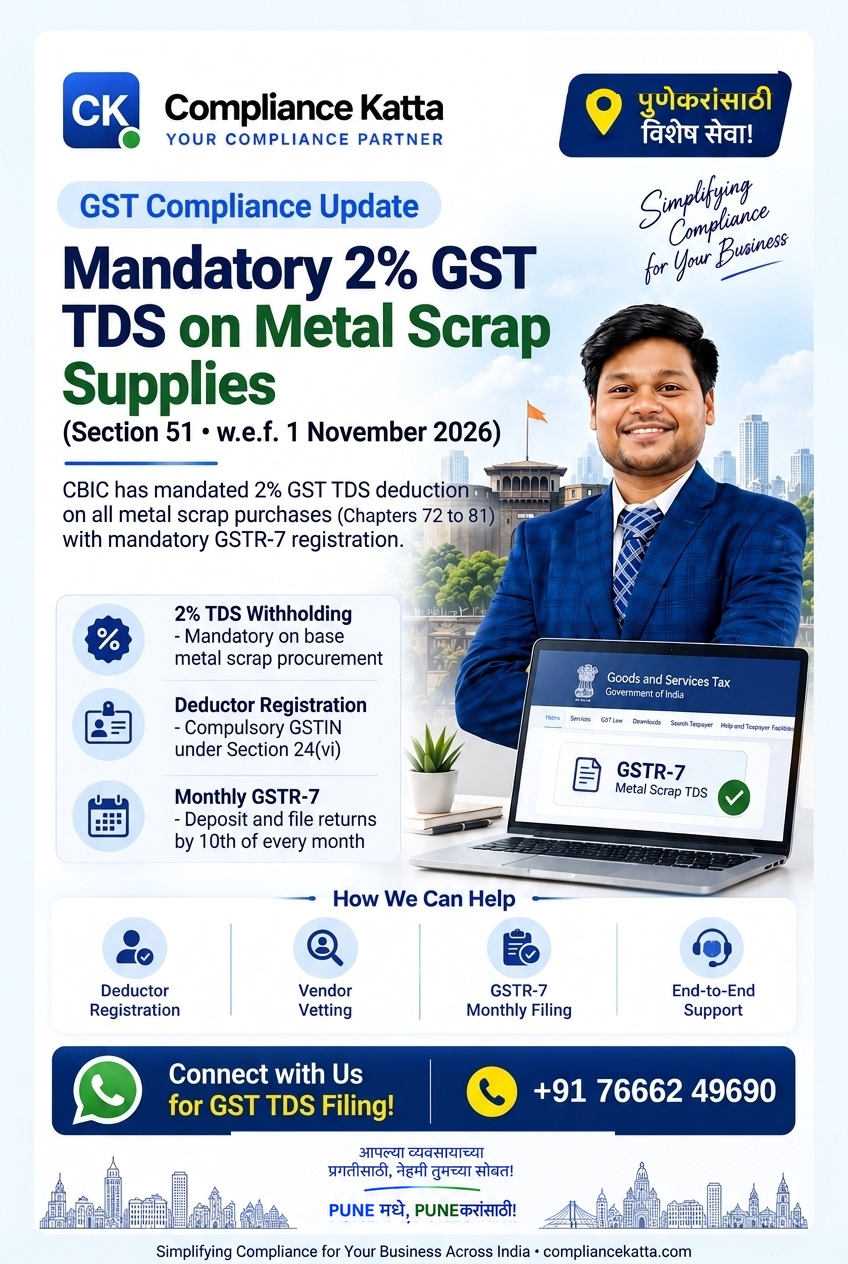
In a significant move to streamline the indirect tax framework and curb tax evasion within the recycling and metal industries, the Central Board of Indirect Taxes and Customs (CBIC) has introduced mandatory Tax Deduction at Source (TDS) on all supplies of metal scrap. Governed by Section 51 of the CGST Act, this regulation is set to take effect from 1 November 2026. For businesses operating in the metal sector, this marks a transition from simple trading to a high-compliance landscape requiring dedicated tax deduction and reporting mechanisms.
The Legal Framework: Section 51 and Metal Scrap
Traditionally, GST TDS was largely applicable to government departments and public sector undertakings. However, recognizing the high volume of informal transactions in the scrap market, the government has extended these provisions to all registered buyers purchasing metal scrap from Chapters 72 to 81 of the HSN code. This means that every time a registered business procures scrap, they must act as a 'tax collector' for the government, ensuring that a portion of the payment is deposited directly into the treasury.
Key Highlights of the Mandatory GST TDS
- TDS Rate: A flat rate of 2% GST TDS (1% CGST + 1% SGST or 2% IGST) must be deducted from the taxable value of the supply.
- Effective Date: The provision becomes enforceable starting 1 November 2026.
- Scope of Materials: Covers all metal scrap items under Chapters 72 to 81 (Iron, Steel, Copper, Aluminum, etc.).
- Mandatory Registration: Every buyer liable to deduct TDS must obtain a separate GST registration as a Tax Deductor.
- Filing Requirements: Monthly reporting via GSTR-7 is mandatory by the 10th of the following month.
Expert Advice from Compliance Katta: Businesses should not wait until October 2026 to prepare. The requirement for a separate registration under Section 24(vi) means your accounting systems and ERPs must be reconfigured to handle two distinct GSTINs for the same entity.
HSN Chapters Covered Under the New Mandate
The mandate is specific to the supply of metal scrap. The following table illustrates the primary metals affected by this notification:
| HSN Chapter | Description of Metal Scrap | TDS Rate Applicable |
|---|---|---|
| Chapter 72 | Iron and Steel Scrap | 2% |
| Chapter 73 | Articles of Iron or Steel (Scrap) | 2% |
| Chapter 74 | Copper and Copper Scrap | 2% |
| Chapter 75 | Nickel and Nickel Scrap | 2% |
| Chapter 76 | Aluminum and Aluminum Scrap | 2% |
| Chapter 78 | Lead and Lead Scrap | 2% |
| Chapter 79 | Zinc and Zinc Scrap | 2% |
| Chapter 80 | Tin and Tin Scrap | 2% |
| Chapter 81 | Other Base Metals and Cermets Scrap | 2% |
Mandatory Registration under Section 24(vi)
One of the most critical aspects of this update is the registration requirement. Even if a business is already registered as a regular taxpayer under GST, they must obtain a separate registration as a Tax Deductor. This is non-negotiable under Section 24(vi) of the CGST Act. This separate GSTIN will be used exclusively for deducting TDS, depositing it with the government, and issuing TDS certificates to suppliers.
The Compliance Workflow: GSTR-7 Filing
The deduction of tax is only the first step. The compliance cycle follows a strict monthly timeline:
1. Deduction: Deduct 2% at the time of payment or credit to the supplier.2. Payment: Deposit the deducted amount using the GST Portal.3. Filing: File Form GSTR-7 by the 10th of the next month.4. Certificate: The TDS certificate is made available to the supplier on their GST portal, allowing them to claim credit in their electronic cash ledger.Compliance Checklist for Metal Scrap Buyers
To ensure a smooth transition by November 2026, businesses should follow this checklist:
- Apply for TDS Registration: Secure a separate GSTIN for TDS purposes under Section 24(vi).
- Update Vendor Master Data: Identify all suppliers falling under HSN Chapters 72-81.
- Accounting Software Configuration: Modify accounting entries to automatically calculate and deduct 2% TDS on applicable invoices.
- Cash Flow Planning: Account for the 2% deduction in cash flow projections, as this amount must be paid to the government before the filing deadline.
- Staff Training: Ensure the accounts team understands the difference between regular GST and GST TDS.
Conclusion
The enforcement of 2% GST TDS on metal scrap is a robust measure to bring transparency to the scrap trade. While it adds a layer of administrative responsibility for buyers, it ensures that tax leakage is minimized across the supply chain. Businesses must take proactive steps to align their operations with these new norms well before the 1 November 2026 deadline to avoid penalties and interest.
For professional assistance with GST TDS registration and monthly GSTR-7 filings, contact Compliance Katta today. We provide end-to-end support to ensure your business remains compliant with the evolving GST landscape.
Contact Details:M.No. +91 76662 49690Email: contact@compliancekatta.comWebsite: compliancekatta.com
Common Questions
Q.Is the 2% TDS applicable to all metal purchases?
No, the 2% GST TDS is specifically applicable only to the supply of metal scrap falling under HSN Chapters 72 to 81. It does not apply to the purchase of finished metal products or fresh metal ingots, provided they are not classified as scrap.
Q.Do I need a new GST number if I already have one for my business?
Yes, under Section 24(vi) of the CGST Act, any person required to deduct tax at source must obtain a separate registration as a Tax Deductor. This is distinct from your regular GST registration used for sales and purchases.
Q.What is the deadline for depositing the deducted TDS and filing the return?
The GST TDS deducted during a particular month must be deposited and the corresponding return in Form GSTR-7 must be filed by the 10th day of the succeeding month. Failure to do so may attract interest and late fees as per GST laws.
Q.What happens if I fail to deduct TDS on metal scrap after November 2026?
Failure to deduct or pay TDS can lead to significant legal consequences, including the payment of the original tax amount, interest at 18% per annum, and potential penalties under Section 122 of the CGST Act. Compliance Katta can help you set up systems to avoid such defaults.
Q.How can the supplier claim the benefit of the 2% deducted as TDS?
Once the buyer files the GSTR-7 return, the TDS amount is reflected in the 'TDS and TCS Credit Received' tab on the supplier's GST portal. The supplier must accept these credits, which then get transferred to their Electronic Cash Ledger, usable for paying their own GST liabilities.