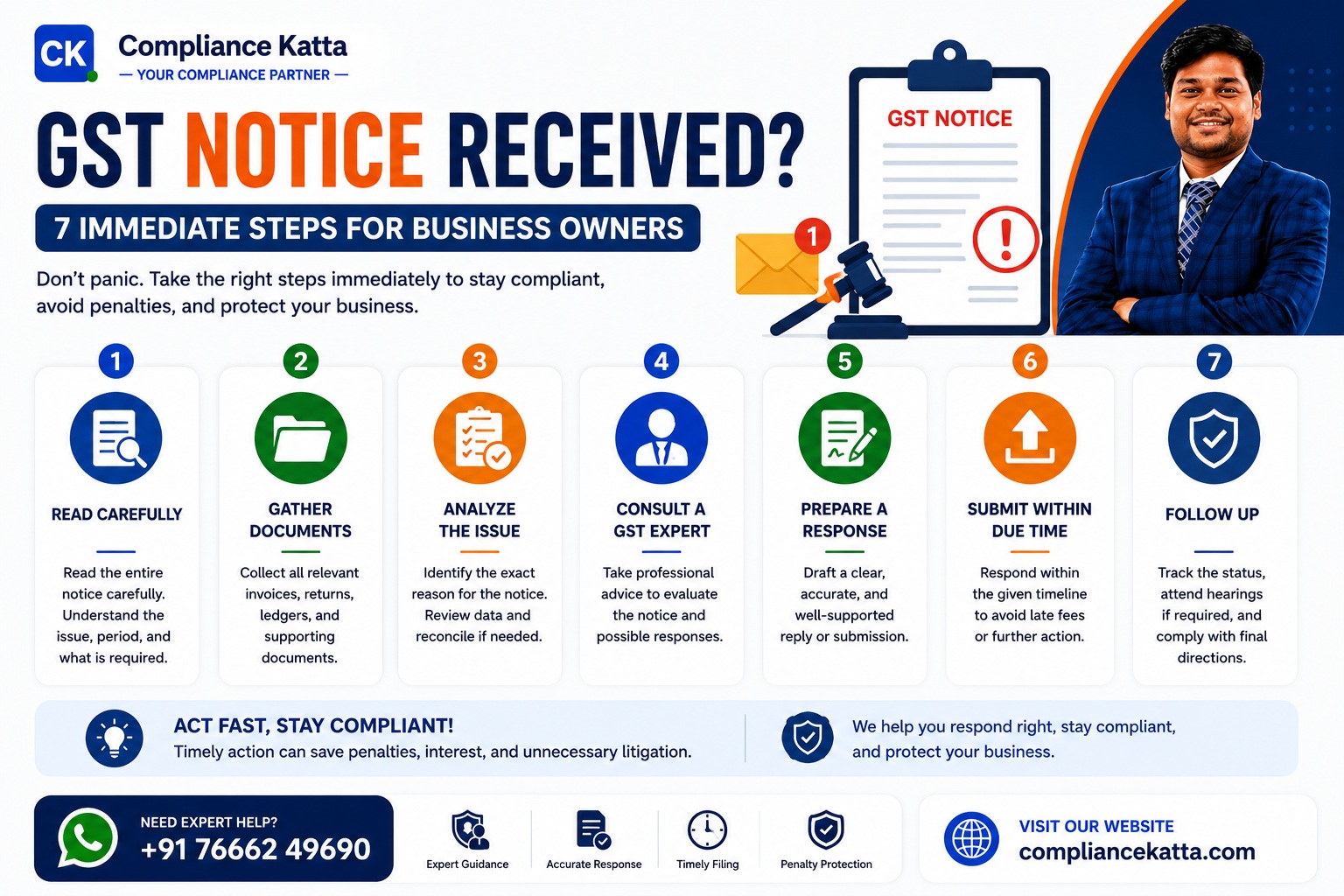
Introduction: Navigating the Complexity of GST Notices
Receiving a notice from the GST department can be a stressful experience for any business owner. With the Indian tax administration becoming increasingly data-driven, scrutiny notices and audits have become more frequent. However, a notice does not necessarily imply a penalty; it is often a request for clarification or documentation. At Compliance Katta, we emphasize that the key to handling tax litigation is a calm, structured, and timely approach. Understanding the legal nuances and responding with precision can save your business from heavy interest and penalties.
The Rise of System-Generated Scrutiny
The GST portal now uses sophisticated AI and data analytics to flag discrepancies between GSTR-1, GSTR-3B, and GSTR-2B. When these systems detect mismatches, they automatically trigger notices under various sections of the CGST Act. Being prepared is the first step toward effective resolution.
1. Verify the Authenticity with DIN (Document Identification Number)
Before you react, you must ensure that the notice is genuine. The CBIC has made it mandatory for every official communication to have a Document Identification Number (DIN). You can verify this on the GST portal or the CBIC website. If a notice lacks a valid DIN, it is legally non-est (does not exist in the eyes of the law) except in specific emergency cases.
Expert Advice: Always verify the DIN first to protect your business from fraudulent communications and ensure the notice is officially recorded in the system.
2. Identify the Type of Notice and the Legal Section
Not all notices are the same. Each notice serves a different purpose and carries different levels of urgency. You must identify the specific section under which the notice is issued. Below is a comparison of common GST notices:
| Notice Type | Section | Purpose |
|---|---|---|
| ASMT-10 | Section 61 | Scrutiny of returns and pointing out discrepancies. |
| DRC-01 | Section 73/74 | Show Cause Notice for demand of tax, interest, or penalty. |
| GST REG-17 | Section 29 | Show Cause Notice for cancellation of GST registration. |
| SUMMONS | Section 70 | Requiring personal appearance or production of documents. |
3. Strict Adherence to Timelines
Most GST notices come with a strict deadline, usually 15 to 30 days from the date of service. Ignoring a notice or missing the deadline can lead to an 'Ex-parte' order, where the tax officer decides the liability without hearing your side. If you need more time, you must formally request an extension via the portal or in writing, citing valid reasons. Compliance Katta recommends marking your calendar the moment a notice is received to avoid last-minute rushes.
4. Perform a 3-Way Reconciliation
The majority of notices arise from data mismatches. You must immediately conduct a thorough reconciliation of three primary data sets:
- Sales Register vs. GSTR-1 & 3B: To check for under-reporting of outward supplies.
- Purchase Register vs. GSTR-2B: To identify excess Input Tax Credit (ITC) claimed.
- E-way Bill Portal vs. GSTR-1: To ensure that physical movement of goods matches your tax filings.
5. Draft a Precise and Legally Sound Reply
Your reply is your primary defense. It should be drafted in a professional manner, addressing every point raised in the notice sequentially. Use strong legal arguments and refer to relevant circulars or case laws where applicable. Ensure that your reply is accompanied by supporting evidence, such as invoices, bank statements, or CA certificates if required. At Compliance Katta, we believe a well-drafted reply can resolve 80% of scrutiny cases at the initial stage itself.
6. Digital Submission and Physical Acknowledgment
In the current GST regime, almost all responses must be submitted online through the GST portal (Services > User Services > View Additional Notices/Orders). However, for complex cases or summons, a physical submission to the jurisdictional officer might be necessary. Always ensure you obtain a stamped acknowledgment for any physical documents submitted. Digital footprints on the portal serve as legal proof of your compliance within the stipulated timeframe.
7. Consult a Professional Compliance Partner
GST laws are dynamic, with frequent amendments and notifications. Attempting to handle complex legal notices without expert guidance can lead to unintended admissions of guilt or procedural errors. Seeking help from a professional firm like Compliance Katta ensures that your case is handled by experts who understand the intricacies of tax litigation and can represent your interests effectively before the authorities.
Compliance Checklist for Business Owners
- Check the 'View Additional Notices' tab on the GST portal weekly.
- Ensure your registered email ID and mobile number are active to receive alerts.
- Maintain a dedicated folder for all tax-related correspondences.
- Do not deposit any disputed tax under pressure without a 'Payment under Protest' note if applicable.
- Review the 'Electronic Liability Register' regularly for any sudden demands.
Conclusion
Receiving a GST notice is a routine part of modern business administration. While it requires immediate attention, it does not signify the end of the road. By following these seven steps—verification, identification, reconciliation, and professional consultation—you can navigate the scrutiny process with confidence. Remember, proactive compliance is always cheaper than reactive litigation. Let Compliance Katta be your partner in ensuring your business remains compliant and focuses on growth without the fear of tax hurdles.
Common Questions
Q.What is the difference between a GST notice and a GST order?
A GST notice is an initial communication from the tax department asking for clarification, documents, or showing cause why a penalty should not be levied. A GST order is the final decision issued by the tax officer after considering your reply, which officially confirms the tax liability, interest, or penalty you are required to pay.
Q.Can I ignore a GST notice if it contains a small mismatch amount?
No, ignoring any GST notice regardless of the amount is highly discouraged. Small discrepancies can lead to the freezing of bank accounts, cancellation of GST registration, or a wider audit of your entire business history. Always respond to every notice to close the matter officially in the system.
Q.How do I check if my GST notice is genuine?
Every genuine GST notice issued by an officer must contain a unique Document Identification Number (DIN). You can verify this DIN on the CBIC's 'Verify DIN' portal. If the notice is not found in the system, it may not be legally valid, and you should consult a professional like Compliance Katta immediately.
Q.What should I do if I cannot gather all documents within the 30-day deadline?
If you cannot gather the required documentation in time, you should file an interim reply or an adjournment application on the GST portal. Clearly state the reasons for the delay and request an extension of 15 to 30 days. Most officers grant a reasonable extension if the request is made before the deadline expires.
Q.How does Compliance Katta help in responding to GST notices?
Compliance Katta provides end-to-end support, including data reconciliation to find the root cause of the notice, drafting a legally sound technical reply, and representing your case before the GST authorities. Our expertise ensures that your response minimizes tax liability and adheres to the latest GST regulations.