Introduction to the 2026 GST Composition Scheme Reforms
In a significant move to bolster the ease of doing business for small taxpayers, the Goods and Services Tax Network (GSTN) and the Central Board of Indirect Taxes and Customs (CBIC) have announced transformative updates to the Composition Scheme under Section 10 of the CGST Act. Effective from November 2026, as per Notification No. 07/2026-Central Tax, the portal introduces enhanced functionalities that automate category management and broaden the scope for mixed suppliers. These changes aim to reduce the compliance burden by replacing manual interventions with real-time portal validations.
The Emergence of Section 10(2A): A Boon for Mixed Suppliers
Traditionally, the Composition Scheme was primarily geared towards manufacturers and traders of goods. However, recognizing the complex nature of modern business, the government has integrated Section 10(2A) directly into the GST portal. This category is specifically designed for taxpayers who provide both goods and services (mixed suppliers) but do not qualify for the standard composition scheme under Section 10(1).
Expert Advice: Transitioning to Section 10(2A) allows service-heavy businesses to enjoy lower compliance hurdles, provided their aggregate turnover remains within the prescribed limits. Compliance Katta recommends a thorough review of your previous year's turnover before switching.
Key Highlights of the New Enhancements
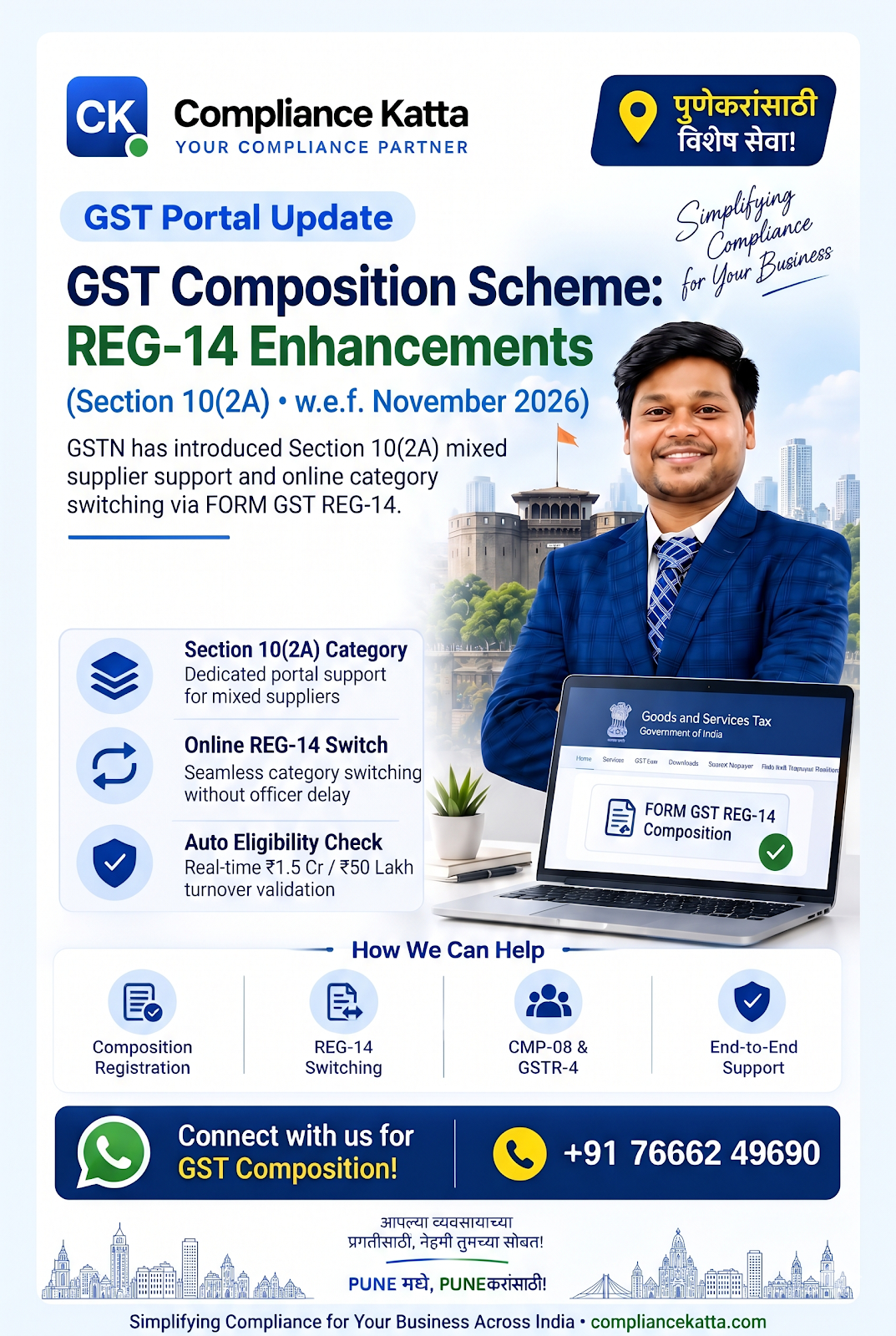
- Integrated Functionality for Section 10(2A): Seamless enrollment for mixed suppliers of goods and services.
- Automated Category Switching: Taxpayers can now switch between different composition sub-categories (e.g., from goods to mixed supply) via FORM GST REG-14.
- No Manual Officer Intervention: The system now processes category updates automatically, eliminating the need for physical visits or officer approvals for non-core amendments.
- Real-time Turnover Validation: The portal will automatically verify eligibility based on the previous year's aggregate turnover data.
Comparative Analysis: GST Composition Categories
| Feature | Section 10(1) & (2) - Goods | Section 10(2A) - Mixed/Services |
|---|---|---|
| Primary Supply | Manufacturers, Traders, Restaurants | Mixed Suppliers and Service Providers |
| Aggregate Turnover Limit | Up to ₹1.5 Crore (₹75 Lakh for special states) | Up to ₹50 Lakh |
| Tax Rate | 1% (Traders/Mfrs), 5% (Restaurants) | 6% (3% CGST + 3% SGST) |
| Switching Mechanism | Online via REG-14 | Online via REG-14 |
| Validation Type | Automated Real-time | Automated Real-time |
Streamlining Category Switching via FORM GST REG-14
The update to FORM GST REG-14 is perhaps the most impactful change for registered taxpayers. Previously, changing business particulars or shifting between tax structures often required complex filings. Starting November 2026, the updated REG-14 serves as a unified digital interface for:
- Updating business activity codes.
- Switching from Section 10(1) to Section 10(2A) and vice versa.
- Updating turnover declarations to reflect current eligibility.
The removal of officer intervention ensures that as soon as a taxpayer submits the amendment in REG-14, the portal validates the data against existing records and updates the taxpayer's profile instantaneously. This significantly reduces the wait time and potential for disputes.
Impact Analysis for Small Taxpayers
The shift towards automation reflects the government's data-driven compliance strategy. By using Automated Eligibility Validation, the portal prevents taxpayers from inadvertently opting for a scheme they are not qualified for based on their aggregate turnover. This proactive approach prevents future penalties and interest that often arise from incorrect scheme selection.
Compliance Checklist for Taxpayers
- Verify Turnover: Ensure your aggregate turnover in the preceding financial year does not exceed ₹1.5 Cr (Goods) or ₹50 Lakh (Services).
- Assess Business Nature: If your service component has increased, consider switching to Section 10(2A) via REG-14.
- Monitor Notifications: Stay updated with Compliance Katta for any further procedural shifts under Notification No. 07/2026.
- Update Portal Details: Ensure your HSN codes and nature of business are correctly updated in the registration core fields to facilitate automated switching.
- Plan Tax Strategy: Analyze whether the 6% rate (Section 10(2A)) or the 1% rate (Section 10(1)) is more beneficial for your business model.
Conclusion
The enhancements to the GST Composition Scheme and the streamlining of FORM GST REG-14 represent a milestone in digital tax administration. By empowering taxpayers to manage their categories without manual oversight, the GSTN has made compliance more transparent and efficient. However, navigating these automated thresholds requires precision in data entry and turnover calculation. For expert advisory and seamless tax planning, partner with Compliance Katta to ensure your business stays ahead of the regulatory curve.
Common Questions
Q.What is the significance of Notification No. 07/2026-Central Tax?
Notification No. 07/2026-Central Tax introduces the legal framework for the technological overhaul of the GST Composition Scheme. It enables the use of Section 10(2A) for mixed suppliers on the portal and facilitates automated category switching via FORM GST REG-14 starting November 2026.
Q.How does the automated category switching in FORM GST REG-14 work?
Taxpayers can now update their business details or switch between composition categories directly on the GST portal using FORM GST REG-14. The portal uses real-time data to validate the request, and since it is an automated process, it no longer requires manual approval or intervention from a tax officer.
Q.Who is eligible for the Section 10(2A) category?
Section 10(2A) is designed for mixed suppliers who provide both goods and services (or services only) and have an aggregate turnover of up to ₹50 Lakh in the preceding financial year. This category allows them to pay tax at a flat rate of 6% (3% CGST + 3% SGST).
Q.What are the turnover limits for the different Composition Scheme categories?
For taxpayers dealing primarily in goods or restaurant services under Section 10(1), the aggregate turnover limit is ₹1.5 Crore (₹75 Lakh for specific North-Eastern and Hilly states). For service providers or mixed suppliers under Section 10(2A), the aggregate turnover limit is ₹50 Lakh.
Q.Can the GST portal block me from opting for the Composition Scheme?
Yes, with the new automated eligibility validation, the portal will check your aggregate turnover in real-time. If your turnover exceeds the prescribed limits of ₹1.5 Crore or ₹50 Lakh, the system will prevent you from selecting the respective composition category to ensure compliance.