In this article
Introduction & Regulatory Context
The Employees' State Insurance Corporation (ESIC), under the Ministry of Labour & Employment, has ushered in a new era of employer compliance with the notification of the Employees' State Insurance (General) Regulations, 2026. These landmark regulations, officially notified on November 20, 2026 (Notification No.: N-12011/1/2026-P&D) and effective from November 21, 2026, completely supersede the archaic Employees' State Insurance (General) Regulations, 1950. This comprehensive overhaul aims to streamline administration, enhance transparency, and introduce modern compliance mechanisms for employers operating across India, including businesses in Pune and pan-India.
The new framework is designed to adapt the ESIC scheme to contemporary administrative practices, emphasizing digital integration and clearer responsibilities for employers. It impacts all establishments covered by the ESIC scheme, typically those with 10 or more employees (or 20+ in some states), and applies to employees earning up to ₹21,000 per month (or ₹25,000 for persons with disability).
Key Highlights of the 2026 Regulations
The Employees' State Insurance (General) Regulations, 2026, introduce several pivotal changes that demand immediate attention from employers:
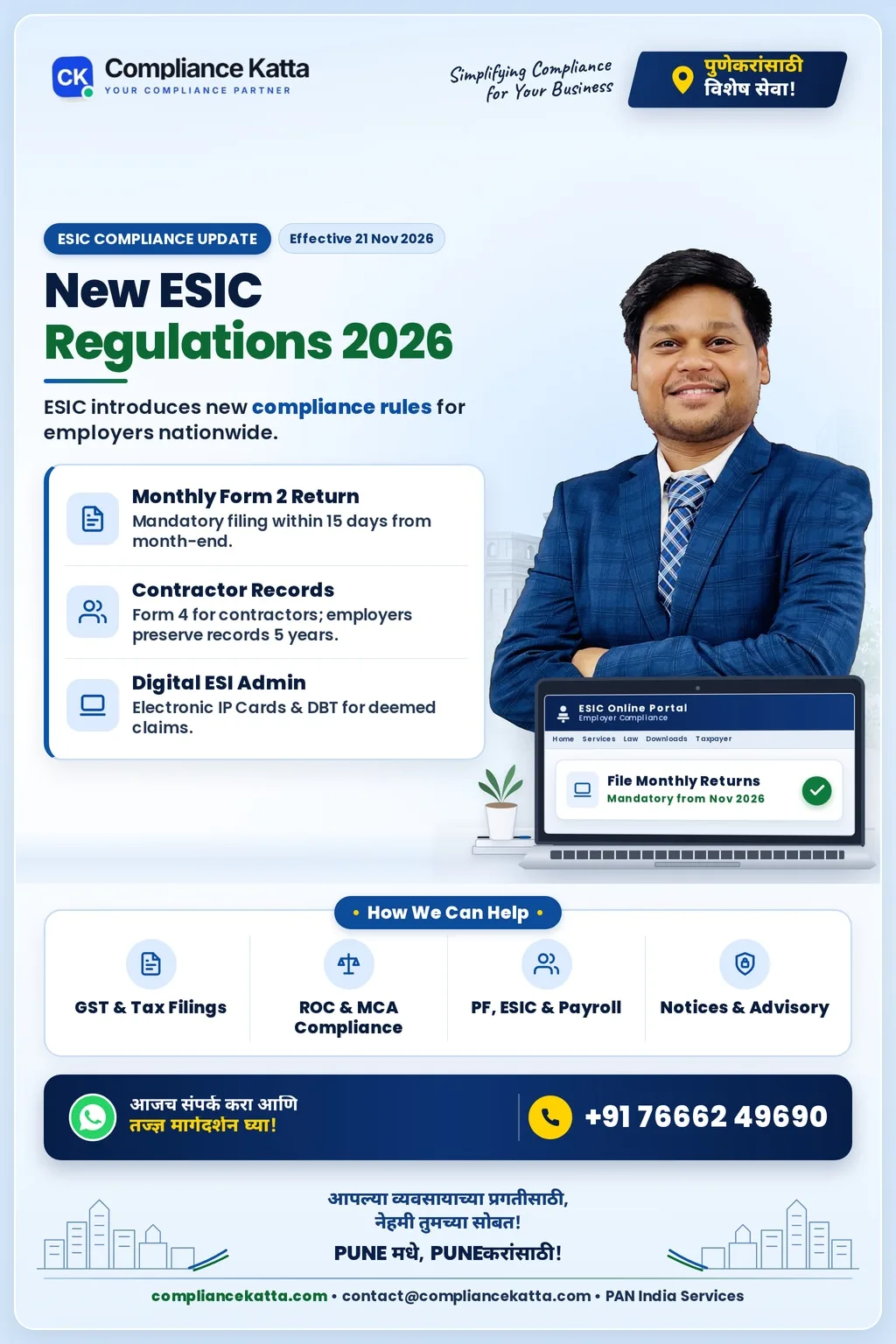
- New Monthly Contribution Return (Form 2): Employers are now mandated to file a monthly contribution return in Form 2. This return must be submitted within 15 days from the end of each month and must meticulously cover all employees, whether directly engaged or through contractors, for whom ESI contributions are payable. This replaces previous reporting mechanisms with a standardized, timely submission.
- Mandatory Contractor Employee Records (Form 4): A significant addition is the requirement for contractors to maintain an employee register in Form 4. This register must be submitted to the principal employer before the settlement of their bills. Concurrently, principal employers are also required to maintain their own employee registers and preserve them for a period of five years from the date of the last entry, ensuring comprehensive record-keeping and accountability.
- Mandatory Employee Nominations: The new regulations introduce explicit provisions for mandatory nominations by employees under the ESI scheme. This ensures clarity regarding beneficiaries and simplifies the process for claiming benefits in unforeseen circumstances.
- Electronic-First Administration and Deemed Claims: ESIC is transitioning towards an electronic-first administrative approach. This includes the electronic generation of the Insured Person Card (IP Card) in Form 1A. Furthermore, sickness and maternity benefits can now be processed as "deemed claims" through Direct Benefit Transfer (DBT). This is possible without requiring a separate claim from the insured person, provided a medical certificate is issued through ESIC's information system, the employer files Form 8B, and the insured person has an Aadhaar-linked bank account.
Comparative Summary & Key Requirements
To better understand the shift, here's a comparative overview of some key aspects:
| Feature | Old Regulations (1950) | New Regulations (2026) |
|---|---|---|
| Monthly Contribution Return | Less formalized, varied reporting | Mandatory Form 2, within 15 days of month-end |
| Contractor Employee Records | Less stringent or specific | Contractors must maintain Form 4; Principal employers preserve records for 5 years |
| Employee Nominations | Often optional or less emphasized | Mandatory provisions introduced |
| Administration & Claims | Primarily manual processes | Electronic-first (Form 1A IP Card), "Deemed Claims" via DBT for sickness/maternity |
Practical Compliance Checklist for Employers
Employers, particularly MSMEs and companies in Pune and across India, must take proactive steps to ensure compliance with these new regulations:
- Review & Update Filing Processes: Immediately integrate the new monthly contribution return in Form 2 into your payroll and compliance calendar. Ensure systems are in place to file within 15 days from the end of each month.
- Engage with Contractors: Communicate the mandatory Form 4 requirement to all contractors. Establish a process to receive Form 4 before bill settlements and ensure your internal records are updated accordingly.
- Facilitate Employee Nominations: Implement procedures to ensure all eligible employees complete their mandatory nominations under the ESI scheme.
- Digital Readiness: Verify that your employees have Aadhaar-linked bank accounts to facilitate "deemed claims" and Direct Benefit Transfer (DBT) for sickness and maternity benefits.
- Record Preservation: Ensure robust systems for preserving employee registers and other relevant ESI records for a minimum period of five years.
Expert Advice from Compliance Katta:The ESIC (General) Regulations, 2026, represent a significant shift towards digital and more stringent compliance. Proactive adaptation is crucial to avoid penalties. Employers should conduct an immediate internal audit of their ESI compliance processes, update their record-keeping practices, and ensure seamless integration with the new electronic-first approach. For any complexities or assistance with implementation, especially for businesses navigating these changes in Pune and pan-India, consulting with compliance experts is highly recommended.
Deadlines, Penalties & Claim Procedures
Adherence to timelines is critical under the new regulations:
- Monthly Return Filing Deadline: The monthly contribution return in Form 2 must be filed within 15 days from the end of each month.
- Late Payment Damages: Late payment of contributions will attract damages at a rate of 1% per month.
- Defective Claim Correction: A defective claim for benefits, if corrected within three months, will be treated as having been filed on time.
- Medical Certificate Submission: For sickness claims, the medical certificate must reach the appropriate office within three days from its date of issue. Failure to do so may result in benefits being limited to the period after submission, although the office has discretion to relax this rule for bona fide delays.
Conclusion
The Employees' State Insurance (General) Regulations, 2026, mark a progressive step by ESIC to modernize and strengthen the social security framework for employees. For employers, this translates into enhanced responsibilities, particularly concerning digital compliance, record-keeping, and timely submissions. Compliance Katta urges all affected businesses to thoroughly understand these changes and implement the necessary adjustments to ensure seamless adherence and avoid potential penalties. Staying informed and proactive is key to navigating this evolving regulatory landscape.
Disclaimer: This update is for general informational and educational purposes only and does not constitute formal legal, tax, or professional advice. Applicability may vary based on specific facts, turnover thresholds, and subsequent notifications. Please consult a qualified professional before acting on this information. For Pune & pan-India compliance assistance, contact Compliance Katta on WhatsApp at +91 76662 49690.
Common Questions
Q.What are the most significant changes introduced by the ESIC (General) Regulations, 2026?
The most significant changes include the mandatory monthly contribution return in Form 2, strict requirements for contractors to maintain and submit employee registers in Form 4, mandatory employee nominations, and a shift towards electronic-first administration with provisions for 'deemed claims' via DBT for sickness and maternity benefits.
Q.Who is impacted by these new ESIC regulations?
These regulations impact all employers across India covered by the ESIC scheme. This primarily includes establishments with 10 or more employees (though some states may notify a threshold of 20+ employees) and applies to employees whose wages are up to ₹21,000 per month (or ₹25,000 for persons with disability).
Q.What is the deadline for filing the new monthly contribution return in Form 2, and what are the penalties for late payment?
The monthly contribution return in Form 2 must be filed within 15 days from the end of each month. Late payment of contributions will attract damages at a rate of 1% per month, making timely compliance crucial to avoid financial penalties.
Q.How do the new regulations simplify claims for sickness and maternity benefits?
The new regulations introduce 'deemed claims' for sickness and maternity benefits. These can now be processed through Direct Benefit Transfer (DBT) without a separate claim from the insured person, provided a medical certificate is issued through ESIC's information system, the employer files Form 8B, and the insured person has an Aadhaar-linked bank account.
Q.What record-keeping requirements are introduced for contractors and principal employers?
Contractors are now required to maintain an employee register in Form 4 and submit it to the principal employer before bill settlement. Principal employers must also maintain their own employee registers and preserve them for a period of five years from the date of the last entry, ensuring comprehensive and long-term record-keeping.