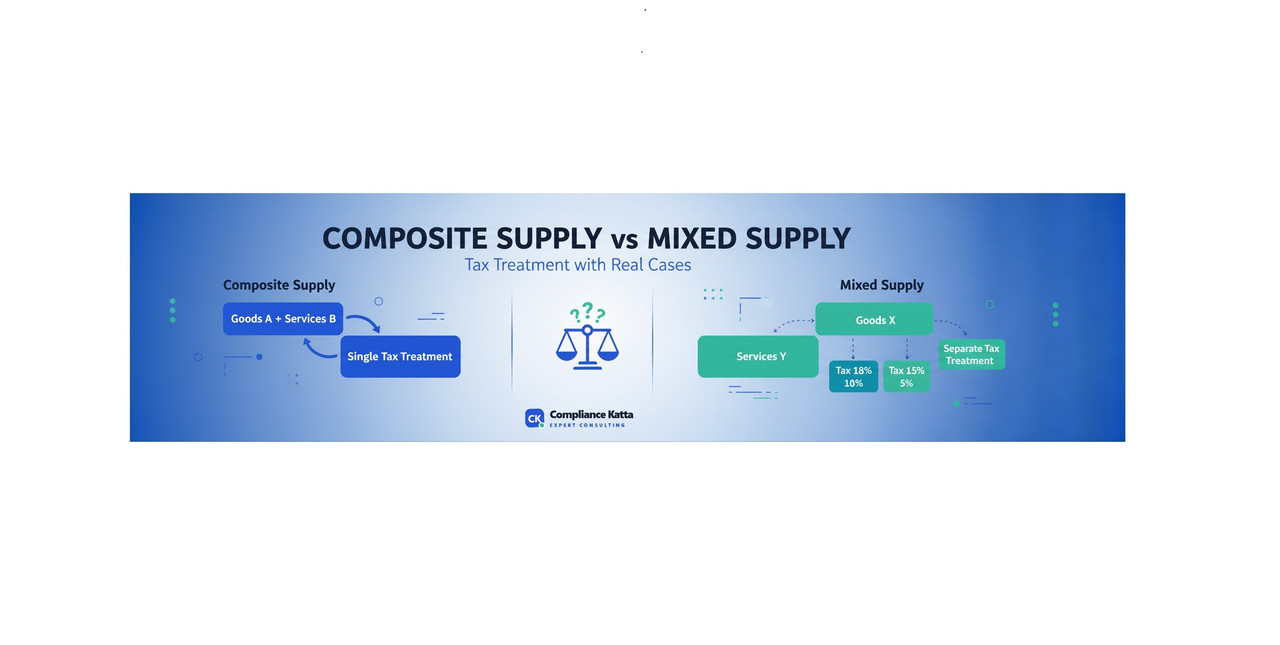
Composite Supply vs. Mixed Supply: Unraveling GST Tax Treatment with Real-World Cases
The Goods and Services Tax (GST) regime in India, while simplifying indirect taxation, often presents nuances that require careful understanding. One such area of complexity lies in classifying different types of supplies, particularly 'Composite Supply' and 'Mixed Supply'. Correct classification is paramount for businesses to ensure accurate tax calculation, avoid penalties, and maintain compliance. This guide will demystify these two crucial concepts, outlining their characteristics, tax treatment, and illustrating them with real-world examples.
Understanding Composite Supply
A Composite Supply, as defined under Section 2(30) of the CGST Act, 2017, refers to a supply comprising two or more supplies of goods or services, or both, which are naturally bundled and supplied in conjunction with each other in the ordinary course of business. One of these supplies is a 'principal supply', and the others are 'ancillary supplies'.
Key Characteristics of Composite Supply:
- Naturally Bundled: The goods or services are usually provided together in the normal course of business. A customer would expect to receive them as a single package.
- One Principal Supply: There is one dominant element that primarily drives the transaction, with other elements serving as incidental or subsidiary to it.
- Cannot be Separated: While technically possible to separate, doing so would significantly alter the nature or value of the principal supply.
- Single Price: Typically offered for a single, consolidated price.
Tax Treatment of Composite Supply:
The entire Composite Supply is treated as a supply of the principal supply. Consequently, the tax rate applicable to the principal supply will be levied on the entire value of the Composite Supply.
Real-World Case:
Imagine you book a flight ticket (principal supply) that includes an in-flight meal and baggage allowance (ancillary supplies). These services are naturally bundled with the air travel. You wouldn't typically purchase the meal or baggage allowance separately without the flight. In this case, the entire value of the flight ticket, including the meal and baggage, will be taxed at the GST rate applicable to air transport service.
Another Example: A hotel provides accommodation (principal supply) along with complimentary breakfast and Wi-Fi access. The breakfast and Wi-Fi are naturally bundled with the room stay. The entire package will be taxed at the GST rate applicable to hotel accommodation.
Understanding Mixed Supply
A Mixed Supply, as defined under Section 2(74) of the CGST Act, 2017, means two or more individual supplies of goods or services, or any combination thereof, made in conjunction with each other by a single supplier for a single price, where such supply does not constitute a Composite Supply.
Key Characteristics of Mixed Supply:
- Not Naturally Bundled: The goods or services are not usually provided together in the ordinary course of business. They can be supplied independently.
- Independent Identity: Each component retains its individual identity and utility.
- Can be Separated: Each item in the bundle can be sold and consumed separately.
- Single Price: Offered for a consolidated price, but the components could have been sold individually.
Tax Treatment of Mixed Supply:
The entire Mixed Supply is treated as a supply of that particular item which attracts the highest rate of tax among all the individual supplies constituting the mixed supply.
Real-World Case:
Consider a festive gift hamper sold by a retail store for a single price. This hamper contains chocolates (GST 18%), fruit juice (GST 12%), and a decorative item (GST 5%). These items are not naturally bundled; they can be sold and purchased individually. Since the chocolate has the highest GST rate (18%), the entire value of the gift hamper will be taxed at 18% GST.
Another Example: An electronics store offers a 'New Year Bundle' comprising a television (GST 28%), a soundbar (GST 18%), and an extended warranty service (GST 18%). Since the television attracts the highest GST rate of 28%, the entire bundle will be taxed at 28%.
Key Differences: Composite vs. Mixed Supply
| Feature | Composite Supply | Mixed Supply |
|---|---|---|
| Nature of Bundling | Naturally bundled in the ordinary course of business. | Not naturally bundled; can be supplied independently. |
| Principal Supply | One dominant 'principal' supply exists. | No principal supply; all components are independent. |
| Separability | Cannot be easily separated without altering the principal supply's nature. | Each component can be sold and consumed separately. |
| Tax Rate | Tax rate of the 'principal supply' applies to the entire bundle. | Highest tax rate among all individual components applies to the entire bundle. |
| Intention | To provide a cohesive, complete service/product. | To offer a convenient bundle, often for promotional purposes. |
Why Correct Classification Matters
Misclassifying a supply can lead to significant tax implications, including:
- Underpayment or Overpayment of Tax: Incorrectly applying a lower or higher GST rate than what is legally due.
- Penalties and Interest: Tax authorities can levy penalties and interest for short payment of tax due to misclassification.
- Disruption of Input Tax Credit (ITC): Incorrect classification might affect the eligibility or availability of ITC for businesses, leading to increased costs.
- Legal Disputes: Potential for disputes with customers or tax authorities, leading to litigation and reputational damage.
Conclusion
The distinction between Composite Supply and Mixed Supply is more than just a theoretical exercise; it has tangible financial and compliance repercussions for businesses under GST. By diligently analyzing the nature of bundling, the existence of a principal supply, and the separability of components, businesses can accurately classify their offerings. Understanding these nuances is crucial for maintaining compliance, optimizing tax liabilities, and ensuring smooth operations in the dynamic GST landscape. When in doubt, consulting with a tax expert is always advisable to navigate these complexities effectively.
Common Questions
Q.What is the fundamental difference between Composite Supply and Mixed Supply under GST?
The fundamental difference lies in the nature of bundling. Composite Supply involves items that are 'naturally bundled' in the ordinary course of business, with one principal supply. Mixed Supply involves items that are 'not naturally bundled' and can be supplied independently, even if sold together for a single price.
Q.How is the tax rate determined for a Composite Supply?
For a Composite Supply, the entire supply is treated as a supply of the 'principal supply'. Therefore, the tax rate applicable to the principal supply will be levied on the entire value of the Composite Supply.
Q.How is the tax rate determined for a Mixed Supply?
For a Mixed Supply, the entire supply is treated as a supply of that particular item which attracts the 'highest rate of tax' among all the individual supplies constituting the mixed supply.
Q.Can you give an example of a Composite Supply?
A common example of a Composite Supply is a flight ticket that includes the air travel service (principal supply), an in-flight meal, and baggage allowance. These are naturally bundled, and the entire package is taxed at the rate applicable to air transport.
Q.Can you give an example of a Mixed Supply?
A typical example of a Mixed Supply is a festive gift hamper containing various items like chocolates, fruit juice, and a decorative item, all sold for a single price. Since these items can be sold separately and are not naturally bundled, the entire hamper will be taxed at the highest GST rate among its components.