In this article
Introduction & Regulatory Context
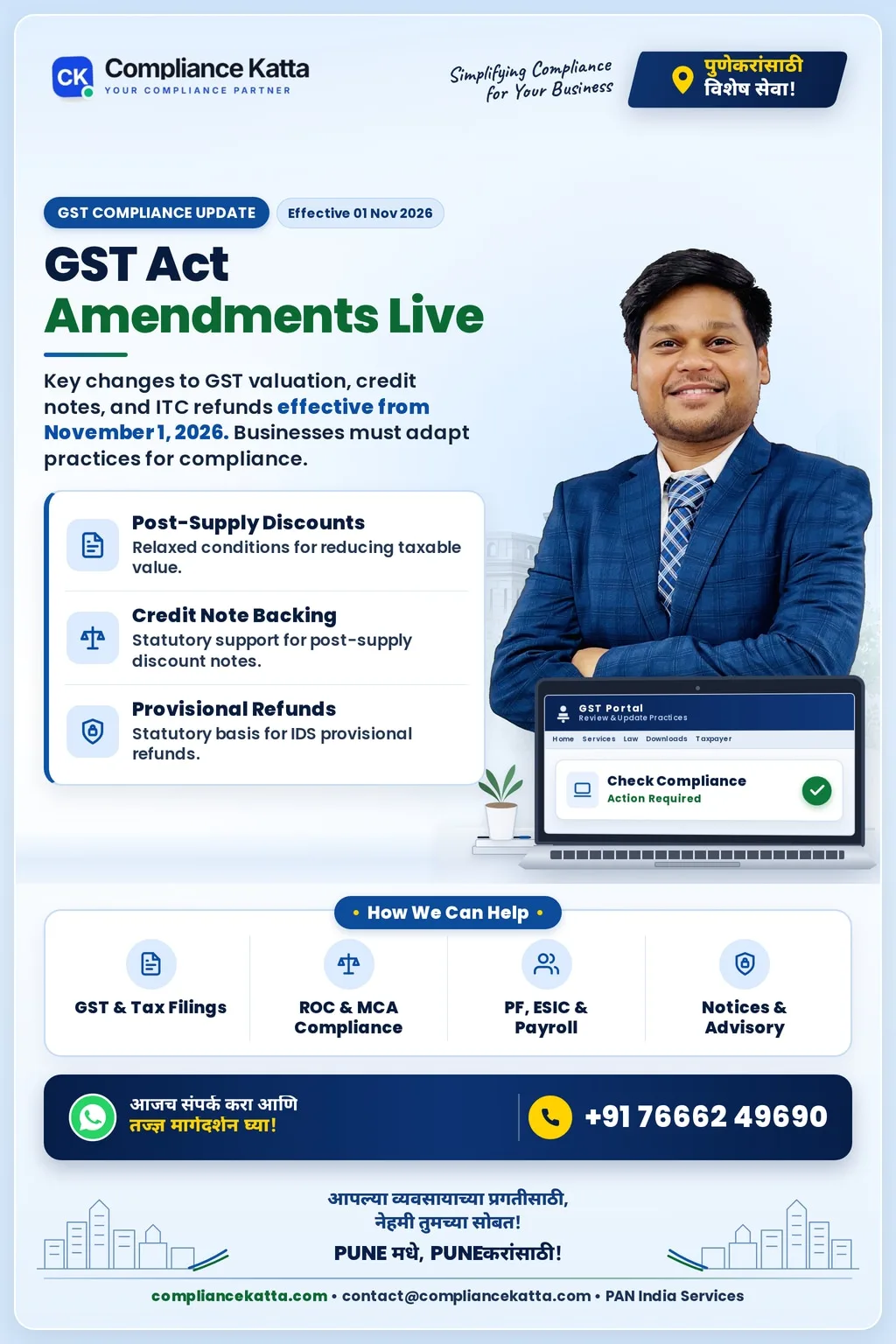
The Central Board of Indirect Taxes and Customs (CBIC) has ushered in a new era of clarity and relief for Goods and Services Tax (GST) registered businesses across India. Through its Notification No. 03/2026–Central Tax, dated October 26, 2026, the CBIC has officially notified the effective date for crucial amendments to the Central Goods and Services Tax (CGST) Act, 2017. These significant changes, stemming from the Finance Act, 2026, came into force on November 1, 2026, and are poised to address long-standing operational challenges faced by businesses, particularly concerning the valuation of taxable supplies, the issuance of credit and debit notes, and the refund of unutilised Input Tax Credit (ITC).
For businesses in Pune and pan-India, especially Small and Medium-sized Enterprises (SMEs) operating in sectors like Fast-Moving Consumer Goods (FMCG), pharmaceuticals, retail, and consumer durables, these amendments are particularly relevant. These sectors frequently deal with complex pricing structures, including year-end incentives, volume rebates, and various post-sale discounts, which previously posed compliance ambiguities. The proactive steps taken by the CBIC aim to streamline GST compliance, reduce litigation, and foster a more business-friendly tax environment.
Key Amendments & Their Implications
The recent amendments target three pivotal sections of the CGST Act, 2017, bringing much-needed statutory clarity and operational flexibility.
Section 15: Valuation of Taxable Supply (Post-Supply Discounts)
One of the most significant changes pertains to the valuation of taxable supplies, specifically addressing post-supply discounts. Previously, businesses struggled to reduce the taxable value for discounts given after the supply if these discounts were not agreed upon at or before the time of supply or were not directly linked to specific invoices. The amendment to Section 15 now relaxes these stringent conditions. Businesses can now reduce the taxable value for discounts provided post-supply, even if the terms were not pre-agreed or invoice-linked. This move acknowledges the commercial realities of various industries where such discounts are common practice, offering substantial relief and reducing potential tax disputes related to valuation.
Section 34: Credit and Debit Notes (Statutory Backing)
Complementing the changes in Section 15, Section 34(1) of the CGST Act has been amended to provide explicit statutory backing for the issuance of credit notes in scenarios involving post-supply discounts. This amendment clarifies that credit notes can be issued for such discounts, provided the recipient of the supply reverses the corresponding input tax credit. This ensures that the tax reduction flows through the supply chain correctly and prevents any undue benefit. This statutory recognition simplifies the process for businesses to adjust their tax liabilities accurately and legally for discounts offered after the original supply.
Section 54: Refund of Unutilised Input Tax Credit (Provisional Refunds & Mechanism Changes)
The amendments to Section 54 of the CGST Act are designed to strengthen the refund mechanism, particularly for unutilised Input Tax Credit. A key highlight is the provision of statutory support for the provisional refund mechanism for claims related to Inverted Duty Structure (IDS). While provisional refunds for IDS were previously managed through administrative instructions, their inclusion in the statute provides a robust legal framework, enhancing certainty and transparency for businesses. Furthermore, the section has undergone broader amendments pertaining to the overall ITC refund mechanism. Businesses are advised to closely monitor for further detailed guidelines and rules that the CBIC may issue to clarify the operational aspects of these changes, ensuring they can effectively claim eligible refunds.
Comparative Overview: Old vs. New Provisions
To better understand the impact of these amendments, here's a comparative summary of the key changes:
| Aspect | Pre-Amendment Position (Before Nov 1, 2026) | Post-Amendment Position (Effective Nov 1, 2026) |
|---|---|---|
| Post-Supply Discounts | Taxable value reduction for post-supply discounts was generally allowed only if agreed at or before supply and linked to specific invoices. | Taxable value can be reduced for post-supply discounts even if not agreed at or before supply, or not linked to specific invoices. |
| Credit Note Issuance | Issuance of credit notes for post-supply discounts not pre-agreed or invoice-linked often lacked explicit statutory backing, leading to ambiguities. | Section 34(1) explicitly permits credit notes for such post-supply discounts, provided the recipient reverses corresponding ITC. |
| Provisional Refunds (IDS) | Provisional refunds for Inverted Duty Structure (IDS) were primarily governed by administrative instructions and circulars. | Statutory support is now provided for the provisional refund mechanism for IDS claims, enhancing legal certainty. |
| ITC Refund Mechanism | General provisions for ITC refunds under Section 54. | Section 54 amended to streamline and clarify the ITC refund mechanism; detailed guidelines awaited. |
Practical Compliance Checklist for Businesses
To ensure seamless compliance with these newly effective amendments, businesses in Pune and across India should undertake the following actions:
- Review Discount Policies: Re-evaluate existing post-sale discount policies and schemes to align them with the relaxed conditions under Section 15. Ensure internal processes can accurately track and account for such discounts for GST valuation purposes.
- Update Credit Note Procedures: Revise internal procedures for issuing credit notes, especially for post-supply discounts. Ensure that the condition of the recipient reversing the corresponding Input Tax Credit is communicated and verified.
- Monitor ITC Refund Guidelines: Stay vigilant for any further detailed guidelines or rules issued by the CBIC concerning the amended Section 54, particularly regarding the unutilised ITC refund mechanism and provisional refunds for IDS.
- System Adjustments: Make necessary adjustments to accounting and GST compliance software to reflect the new valuation and credit note rules. This includes ensuring accurate reporting in GSTR-1 and GSTR-3B.
- Internal Training: Conduct training sessions for finance, sales, and compliance teams to ensure they are fully aware of these changes and their implications for daily operations and reporting.
Expert Advice from Compliance Katta: These amendments represent a significant step towards simplifying GST compliance and reducing the burden on businesses, especially those with dynamic pricing strategies. While the relaxations for post-supply discounts are welcome, it is crucial to maintain robust documentation and ensure recipient ITC reversal for credit notes. Proactive adaptation of your systems and processes is key to leveraging these changes effectively and avoiding future compliance issues. For tailored advice and assistance with GST valuation, credit note procedures, or ITC refund claims, reach out to Compliance Katta.
Conclusion
The notification of these amendments to Sections 15, 34, and 54 of the CGST Act, 2017, effective November 1, 2026, marks a progressive move by the CBIC. By providing statutory clarity on post-supply discounts, strengthening the credit note mechanism, and formalising provisional refunds for IDS, the government has addressed critical pain points for the business community. Businesses must now proactively review their operational and compliance frameworks to fully integrate these changes, ensuring accurate valuation, proper credit note issuance, and efficient ITC refund claims. Staying informed and adapting quickly will be paramount for maintaining compliance and optimising tax positions in the evolving GST landscape.
Disclaimer: This update is for general informational and educational purposes only and does not constitute formal legal, tax, or professional advice. Applicability may vary based on specific facts, turnover thresholds, and subsequent notifications. Please consult a qualified professional before acting on this information. For Pune & pan-India compliance assistance, contact Compliance Katta on WhatsApp at +91 76662 49690.
Common Questions
Q.What is the main purpose of these amendments to the CGST Act?
The primary purpose of these amendments, effective November 1, 2026, is to address long-standing business challenges related to the valuation of taxable supplies, the issuance of credit and debit notes, and the refund of unutilised Input Tax Credit (ITC), thereby streamlining GST compliance and reducing litigation.
Q.How do the changes impact businesses offering post-sale discounts?
Businesses can now reduce the taxable value for discounts given after the supply, even if these discounts were not agreed upon at or before the time of supply and were not linked to specific invoices. This provides significant relief and aligns GST valuation with commercial realities.
Q.What is the significance of the amendment to Section 34 regarding credit notes?
The amendment to Section 34(1) explicitly provides statutory backing for issuing credit notes for such post-supply discounts. This is crucial, provided the recipient of the supply reverses the corresponding input tax credit, ensuring proper tax adjustment across the supply chain.
Q.How does the Section 54 amendment affect ITC refunds, especially for Inverted Duty Structure (IDS)?
The amendment provides statutory support for the provisional refund mechanism for claims related to Inverted Duty Structure (IDS), which was previously based on administrative instructions. Additionally, Section 54 has been generally amended to refine the overall ITC refund mechanism, with further detailed guidelines expected.
Q.Are there any new deadlines or penalties introduced by this notification?
No, the notification primarily establishes the effective date (November 1, 2026) for these legislative amendments. It does not introduce new specific deadlines, late fees, or penalties. However, businesses must align their practices to ensure compliance and avoid potential disputes.