In this article
Introduction & Regulatory Context
The Central Board of Direct Taxes (CBDT), under the Ministry of Finance, has released a pivotal notification that directly impacts Indian businesses involved in international and specified domestic transactions. Issued on November 25, 2026, this update, known as the Income-tax (Removal of Difficulties) Order, 2026, under Section 535 of the Income-tax Act, 2025, provides much-needed clarity on the acceptable tolerance range for Arm's Length Price (ALP) determination for Assessment Year 2026-27. This move is critical for ensuring compliance and reducing potential disputes related to transfer pricing adjustments.
Transfer pricing regulations aim to ensure that transactions between associated enterprises are conducted at an arm's length, meaning at a price that would have been charged between independent parties. The tolerance range provides a practical margin within which the actual transaction price will be deemed to be at arm's length, even if it deviates slightly from the precisely calculated ALP. This notification is a significant step towards streamlining compliance for taxpayers across Pune and Pan-India.
Key Provisions: Tolerance Ranges & Applicability
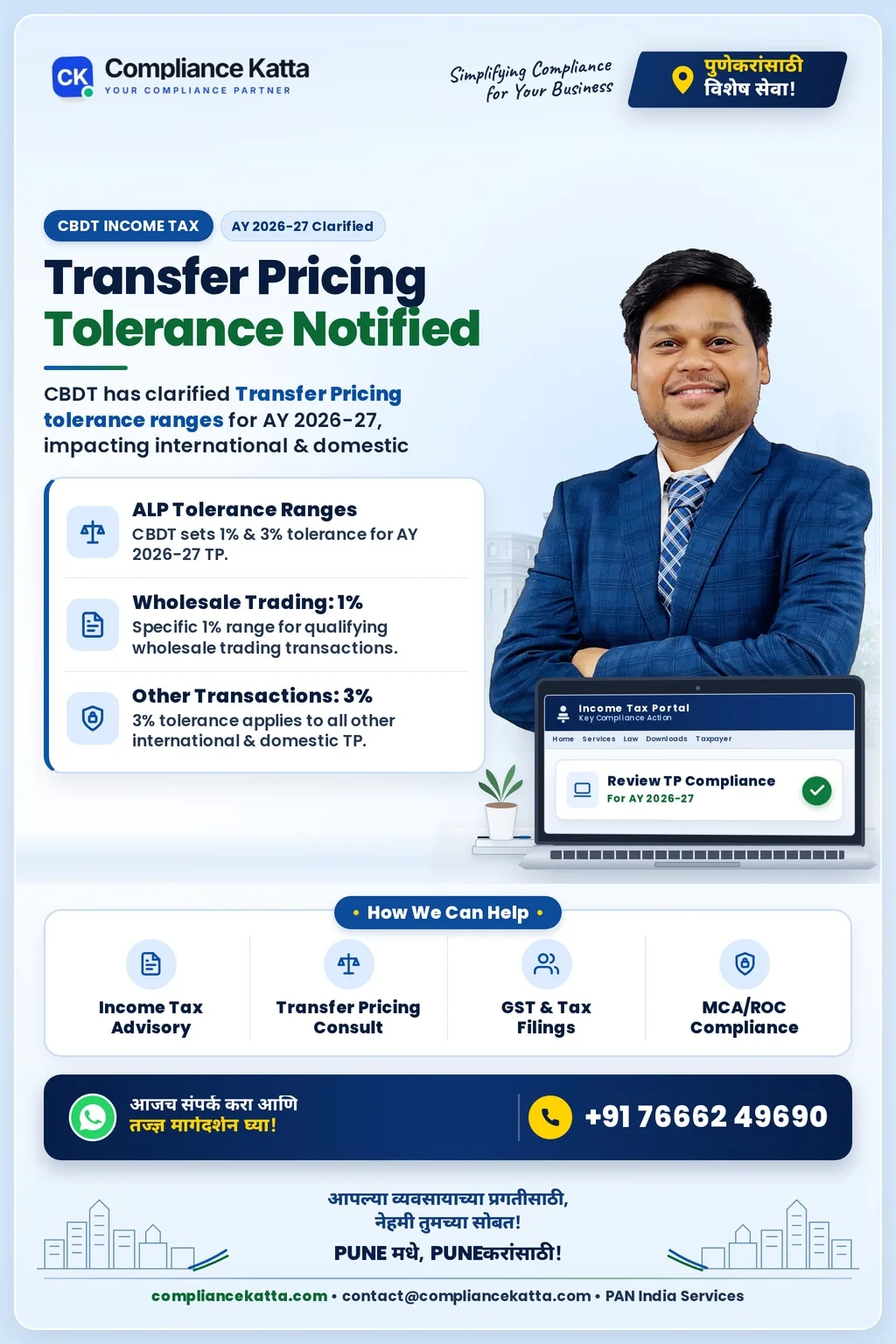
The CBDT's Notification No. 153/2026 specifically prescribes distinct tolerance ranges based on the nature of the international or specified domestic transaction. This differentiation acknowledges the varying risk profiles and operational complexities across different business activities.
- Wholesale Trading Transactions: For international or specified domestic transactions classified as wholesale trading, a tolerance range of 1% has been notified. This lower percentage reflects the generally tighter margins and higher volume nature of such activities.
- All Other Cases: For all other categories of international and specified domestic transactions, a more general tolerance range of 3% is applicable. This covers a broad spectrum of transactions, including manufacturing, services, intangibles, and other non-wholesale trading activities.
The core principle is that if the difference between the ALP determined under Section 92C of the Income-tax Act, 1961, and the actual transaction price does not exceed the prescribed tolerance range, the actual transaction price will be treated as the Arm's Length Price. This provision offers a practical safe harbor for taxpayers, mitigating the need for extensive adjustments for minor deviations.
Defining "Wholesale Trading" for TP
To qualify for the more stringent 1% tolerance range, an international or specified domestic transaction involving the trading of goods must meet two specific conditions. These conditions are designed to precisely identify genuine wholesale trading activities:
- Purchase Cost Criterion: The purchase cost of finished goods must constitute 80% or more of the total cost relating to the trading activities. This ensures that the primary activity is indeed trading, with minimal value addition through manufacturing or processing.
- Inventory Level Criterion: The average monthly closing inventory of such goods must be 10% or less of the sales relating to those trading activities. This condition aims to distinguish high-turnover trading operations from those with significant inventory holding periods, which might imply different business models.
Taxpayers must meticulously document and demonstrate compliance with both these conditions to avail the 1% tolerance range. Failure to meet either criterion would automatically place the transaction under the 3% general tolerance range.
Comparative Summary & Key Requirements
Here's a quick overview of the notified tolerance ranges and their conditions:
| Category of Transaction | Tolerance Range | Conditions for Applicability |
|---|---|---|
| Wholesale Trading (International or Specified Domestic) | 1% |
|
| All Other International and Specified Domestic Transactions | 3% | Applies to all transactions not qualifying as wholesale trading. |
Expert Advice from Compliance Katta: Businesses in Pune and across India must proactively review their international and specified domestic transactions for Assessment Year 2026-27 against these new tolerance ranges. Accurate classification of transactions, especially for wholesale trading, and robust documentation are paramount. Early assessment can help identify potential transfer pricing adjustments and allow for timely corrective actions, thereby avoiding future litigation and penalties. We recommend a thorough analysis of your cost structures and inventory management practices to ensure compliance.
Compliance Implications & Risk Mitigation
While this notification does not introduce new deadlines or penalties, its adherence is critical for taxpayers. Non-compliance with the prescribed ALP principles, even within these tolerance ranges, can lead to significant consequences:
- Transfer Pricing Adjustments: If the transaction price falls outside the notified tolerance range, the tax authorities may make adjustments to the declared price, increasing the taxable income.
- Interest and Penalties: Such adjustments can attract interest under Section 234B and 234C, and potentially penalties under Section 270A or 271AA of the Income-tax Act, 1961, for misreporting of income or failure to maintain proper documentation.
- Litigation Risk: Discrepancies in transfer pricing can lead to prolonged disputes with tax authorities, consuming valuable time and resources.
Taxpayers should undertake the following actions:
- Identify Applicable Transactions: Clearly identify all international and specified domestic transactions for AY 2026-27.
- Classify Transactions: Accurately classify transactions as wholesale trading or 'other cases' based on the defined criteria.
- Document Thoroughly: Maintain comprehensive documentation supporting the ALP determination and the classification of transactions, including cost breakdowns and inventory records.
- Review & Adjust: Compare actual transaction prices with the ALP and ensure they fall within the respective tolerance ranges. Make necessary adjustments proactively if deviations are found.
Conclusion
The CBDT's notification of transfer pricing tolerance ranges for Assessment Year 2026-27 is a crucial development for Indian businesses. It provides a clear framework for compliance, offering a degree of certainty in transfer pricing matters. By understanding and diligently applying these new rules, taxpayers can significantly mitigate their compliance risks and ensure smoother tax assessments. Compliance Katta is committed to assisting businesses across Pune and Pan-India in navigating these complex regulatory landscapes.
Disclaimer: This update is for general informational and educational purposes only and does not constitute formal legal, tax, or professional advice. Applicability may vary based on specific facts, turnover thresholds, and subsequent notifications. Please consult a qualified professional before acting on this information. For Pune & pan-India compliance assistance, contact Compliance Katta on WhatsApp at +91 76662 49690.
Common Questions
Q.What is the primary purpose of the CBDT's transfer pricing tolerance range notification?
The primary purpose is to provide clarity and a defined margin for accepting transaction prices as Arm's Length Price (ALP) for Assessment Year 2026-27. This helps taxpayers avoid potential transfer pricing adjustments and related penalties by ensuring their international and specified domestic transactions are deemed compliant if they fall within the prescribed range.
Q.Who is specifically impacted by this CBDT notification?
This notification impacts all taxpayers engaged in international transactions and specified domestic transactions that are subject to transfer pricing provisions under the Income-tax Act, 2025. This includes a wide array of Indian companies and businesses with cross-border dealings or certain domestic transactions with related parties.
Q.How do I determine if my transaction qualifies for the 1% wholesale trading tolerance range?
To qualify for the 1% tolerance range, an international or specified domestic transaction involving the trading of goods must meet two conditions: (a) the purchase cost of finished goods must constitute 80% or more of the total cost relating to the trading activities, and (b) the average monthly closing inventory of such goods must be 10% or less of the sales relating to those trading activities.
Q.What are the potential consequences if my transaction price falls outside the prescribed tolerance range?
If your transaction price falls outside the prescribed tolerance range, it may lead to transfer pricing adjustments by tax authorities, increasing your taxable income. This can further attract interest under Sections 234B and 234C, and potentially penalties under Section 270A or 271AA of the Income-tax Act, 1961, for non-compliance with ALP principles.
Q.Does this CBDT notification introduce any new filing deadlines or compliance dates?
No, this notification itself does not introduce new filing deadlines or compliance dates. It addresses the determination of ALP for the tax year ending March 31, 2026, corresponding to Assessment Year 2026-27. However, adhering to these tolerance ranges is crucial for timely and accurate compliance with existing income tax provisions and avoiding future complications.