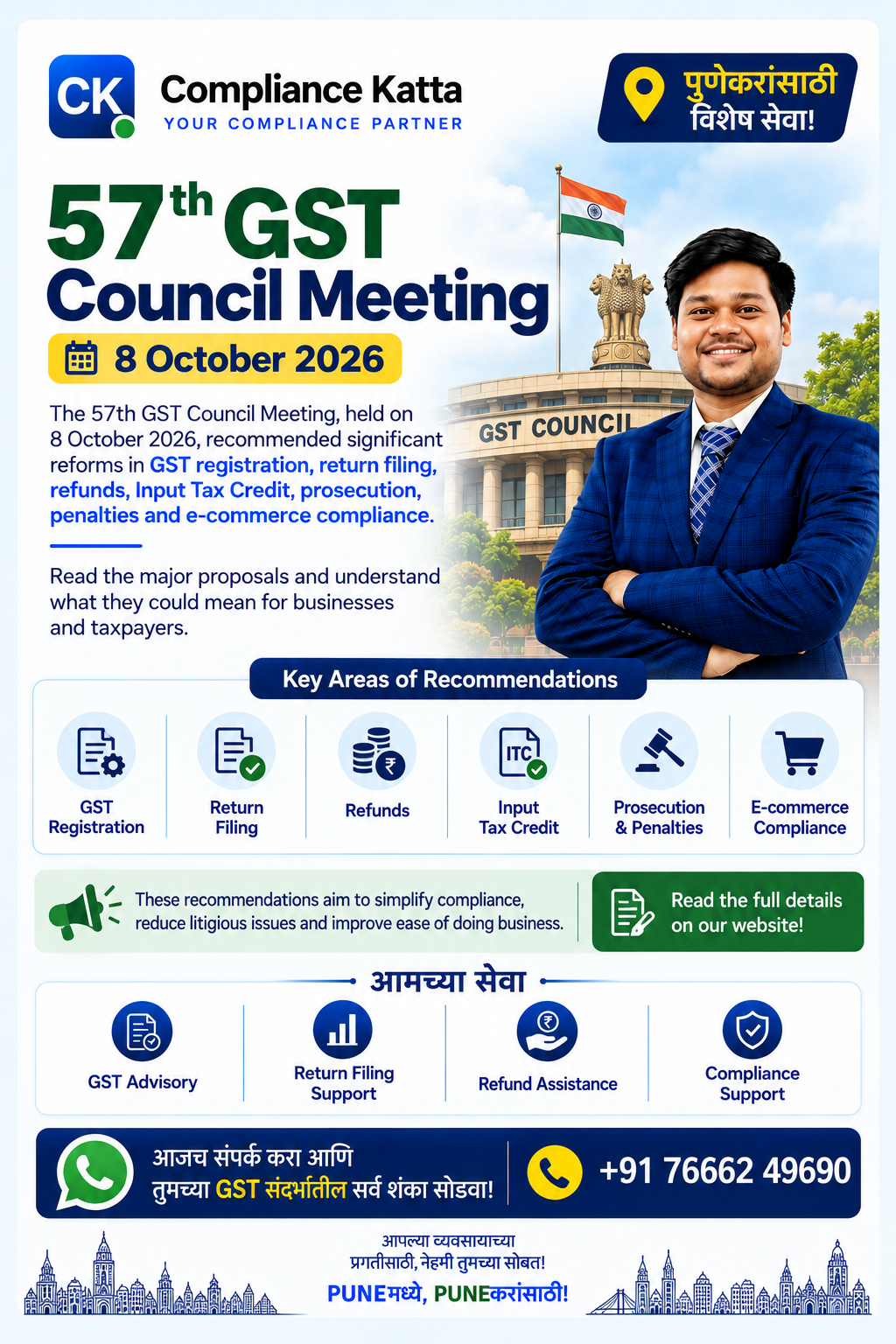
57th GST Council Meeting 2026: Major GST Recommendations, ITC, Refunds and Compliance Reforms
The 57th GST Council Meeting was held on 8 October 2026 in New Delhi under the chairpersonship of Union Finance and Corporate Affairs Minister Smt. Nirmala Sitharaman. The Council recommended significant changes relating to GST registration, return filing, refunds, input tax credit (ITC), prosecution, penalties, dispute resolution and trade facilitation.
Unlike the previous meeting, which focused on rate rationalisation, the 57th meeting primarily focused on simplifying GST procedures and improving compliance. This article explains the major recommendations and their potential implications for businesses and taxpayers.
1. Simplification of GST Registration
The Council recommended clearer guidelines on documents and information required for GST registration, along with FAQs and improvements to Form GST REG-01. The proposed portal enhancements include dropdown lists, tooltips and contextual guidance.
The Council also recommended automatic acceptance of amendments to registration particulars, except changes relating to the principal place of business, subject to the applicable provisions. For taxpayers registered under Rule 14A, automatic acceptance is proposed to cover all registration particulars, including the principal place of business.
2. Simplified GST Registration Cancellation
The Council recommended a phased system-based cancellation process. In the first phase, eligible applications in Form GST REG-16 would be accepted automatically after pending returns are filed and outstanding dues are paid, subject to specified conditions. A later phase proposes extending automatic acceptance to all cancellation applications once the applicable conditions are met.
3. Improvements in GST Return Filing and ITC Reconciliation
The Council recommended improvements to GSTR-1, GSTR-1A and IFF to facilitate better reconciliation with GSTR-3B. Other proposals include an electronic statement for tax paid under reverse charge and ITC claimed, improved correction mechanisms for tax liability and ITC, and an Electronic Credit Reversal and Reclaim Statement.
Changes to the Invoice Management System (IMS) are also proposed to allow recipients, subject to conditions, to accept, reject or keep certain inward supply documents pending for the purpose of generating GSTR-2B.
The proposed alternate mechanism may be brought into force from the return period of April 2027. The Council also recommended time-bound public consultation on the proposed mechanism.
4. Faster and Automated GST Refunds
The Council recommended a phased approach to system-based refund processing. In Phase 1, full refunds of eligible excess balances in the electronic cash ledger are proposed to be sanctioned automatically. The period for issuing an acknowledgement or deficiency memo is proposed to be reduced from 15 days to 10 days.
For eligible refund claims relating to zero-rated supplies and inverted duty structure, 90% of the amount claimed is proposed to be sanctioned provisionally through an automated, risk-based system in Phase 1.
Further proposals include system-based acknowledgement and automated sanction of eligible zero-rated supply refunds in Phase 2, subject to verification, risk assessment and adjustment of pending dues where applicable. The Council also recommended changes to refund applications and specified refund-related provisions.
5. Changes to Input Tax Credit Eligibility
The Council recommended changes to Section 17(5) of the CGST Act to remove restrictions on ITC for specified categories, including outdoor catering, health and life insurance, telecommunication towers, certain pipelines laid outside factory premises, free samples, and goods destroyed or written off on expiry of shelf life as required by law.
These are proposed amendments, and businesses should verify the final legal provisions and applicable conditions before claiming ITC.
6. Refund of ITC on Capital Goods and Input Services
The Council recommended expanding refund eligibility for accumulated ITC on capital goods in cases involving zero-rated supplies, and on input services and capital goods in cases involving inverted duty structure.
The release specifies that refund of accumulated ITC on input services for inverted duty structure would be available for ITC availed on or after 1 November 2026. Refund of ITC on capital goods would be spread over 60 months and would apply to ITC availed on or after 1 April 2027, subject to the proposed provisions.
7. GST Arrest and Prosecution Proposals
The Council recommended complete withdrawal of GST arrest powers through omission of Section 69 of the CGST Act. It also recommended increasing the monetary threshold for prosecution from ₹1 crore to ₹5 crore.
Other proposed changes concern specified offences under Section 132 and rationalisation of punishment for various offences. These proposals should not be interpreted as the immediate removal of existing legal powers or offences; implementation depends on the relevant legislative amendments.
8. Reduction in General Penalty
The Council recommended reducing the maximum general penalty under Section 125 of the CGST Act from ₹25,000 to ₹10,000. This proposal concerns the maximum general penalty under that section and should not be confused with every penalty applicable under GST law.
The Council also recommended a minimum threshold of ₹10,000 for issuance of specified show cause notices, along with certain changes to penalties in non-fraud cases and limits on appeal pre-deposits in cases involving only penalty and no tax demand.
9. Common Standards for GST Notices and Proceedings
The Council recommended comprehensive guidance for tax officers concerning demand notices, adjudication orders and appeal orders. The proposed guidance addresses the quality and timely issuance of notices and orders, proper invocation of fraud-related grounds based on the merits of each case, and adherence to principles of natural justice, including personal hearings.
10. E-Way Bill and Movement of Goods
The Council recommended changes to the interception, detention and seizure framework. Under the proposal, a conveyance carrying goods may be intercepted on specific intelligence and with authorisation from an officer not below the rank of Joint Commissioner. Inspection and further action would generally be linked to the supplier or recipient being located or registered in the State where interception occurs, subject to specified exceptions.
Exceptions include cases where no e-way bill has been generated or the conveyance does not carry documents showing the origin or destination of the goods, as applicable. The proposals aim to improve transportation efficiency and reduce unnecessary disruption to legitimate trade.
11. Simplified Registration for Small E-Commerce Sellers
The Council recommended a simplified registration mechanism for eligible small suppliers of goods selling through e-commerce operators in States or Union Territories where they do not have a physical presence. The proposal includes specified conditions relating to ITC passed on, declaration of an e-commerce operator's warehouse as the principal place of business and automatic system-based registration.
The mechanism is intended to help eligible sellers expand into other States without establishing a separate physical place of business in each State.
12. Optional Annual Return Quarterly Payment Scheme (ARQP)
The Council approved in principle a concept note for an optional Annual Return Quarterly Payment (ARQP) scheme for taxpayers whose aggregate turnover in the preceding financial year does not exceed ₹5 crore and who are engaged exclusively in supplies to unregistered persons (B2C supplies).
This is an in-principle approval of a concept note, not confirmation that the scheme is already operational. Taxpayers should await the detailed rules and implementation instructions.
13. Measures to Facilitate Export of Services
The Council recommended changes to the definition and place-of-supply provisions relevant to certain services supplied by Indian businesses to foreign recipients. The proposals are intended to facilitate access to export-related benefits and refunds in specified circumstances, including certain transactions involving foreign offices or branches.
The Council also recommended clarification on permissible receipt of export consideration in foreign exchange or Indian rupees, where allowed.
14. Other Important GST Recommendations
- Clarification of GST treatment for transfer of intellectual property rights as a supply of services.
- A proposed mechanism for taxpayers to object to the blocking of amounts in the electronic credit ledger and obtain a personal hearing under Rule 86A.
- Recommended relief from late fees for qualifying taxpayers with preceding-year turnover up to ₹5 crore, subject to the stated filing deadline and conditions.
- Clarifications concerning Input Service Distributor (ISD) credit distribution, banking companies, demonstration vehicles and appeal pre-deposits.
- Specified changes and clarifications relating to goods, transport and other services, including certain electric vehicle passenger transport services, delivery services through e-commerce operators, warehousing of seeds meant for sowing and other listed categories.
15. What Should Businesses Do Now?
- Continue complying with the GST provisions currently in force.
- Reconcile GSTR-1, GSTR-3B, GSTR-2B and books of accounts regularly.
- Review ITC eligibility and maintain appropriate supporting documents.
- Monitor official notifications, circulars and amendments before changing filing or refund practices.
- Review the applicability of each recommendation with a qualified GST professional.
Conclusion
The 57th GST Council Meeting placed significant emphasis on simplifying GST compliance, improving refund processing, streamlining registration and return filing, and rationalising specified penalty and prosecution provisions. The proposals could benefit businesses by reducing procedural friction and improving certainty, subject to the final legal framework.
Important disclaimer: This article summarises recommendations in the PIB press release dated 8 October 2026. As stated in that release, the recommendations will be given effect through relevant circulars, notifications and legislative amendments, which alone will have the force of law. Readers should refer to the applicable official documents before acting on any proposal.
For more GST updates, tax insights and compliance support, follow Compliance Katta – Your Compliance Partner.
Common Questions
Q.When was the 57th GST Council Meeting held?
The 57th GST Council Meeting was held on 8 October 2026 in New Delhi under the chairpersonship of Union Finance Minister Nirmala Sitharaman.
Q.What changes were recommended regarding GST prosecution?
The Council recommended reducing the maximum general penalty under Section 125 of the CGST Act from ₹25,000 to ₹10,000. The recommendation should not be treated as an effective amendment until the relevant legal changes take effect.
Q.What GST refund changes were recommended in the 57th GST Council Meeting?
The Council recommended automated processing of eligible excess electronic cash ledger refunds and provisional sanction of 90% of eligible refund claims relating to zero-rated supplies and inverted duty structure in Phase 1, subject to system-based risk assessment and applicable conditions.
Q.What is the proposed ARQP scheme for small businesses?
ARQP stands for Annual Return Quarterly Payment. The Council approved in principle a concept note for an optional scheme for qualifying taxpayers with preceding-financial-year aggregate turnover up to ₹5 crore who make supplies exclusively to unregistered persons (B2C). The detailed implementation framework remains subject to the relevant official measures.
Q.What changes were recommended regarding GST prosecution?
The Council recommended increasing the monetary threshold for prosecution from ₹1 crore to ₹5 crore and withdrawing GST arrest powers through a proposed omission of Section 69 of the CGST Act. These recommendations require the relevant legal amendments to take effect.